Visa Interview Success for Americans Abroad: Questions to Expect, How to Answer, and What Not to Say
Your visa interview is a short conversation with high stakes. Here are the questions to expect, how to answer clearly, and what not to say.

You're standing in your entryway, documents in one hand, phone in the other. Your partner asks, "What if they ask why you're leaving?" and you realize you have a reason, but it's not in interview language yet.
Visa interview success for Americans abroad is mostly about reducing uncertainty. You explain your plan in a simple, consistent way, you match your answers to your application, and you avoid phrases that signal you didn't read the rules.
This guide walks you through the questions you're most likely to hear, a clear answer structure you can use on the spot, and the statements that tend to backfire. It also includes real scenarios you can copy and adapt.

The goal of your visa interview is clarity, not storytelling
The interview feels like a test. It is not. It's a fact-check.
You're not trying to impress the officer. You're trying to make it easy to believe your answers and easy to see that you meet the visa requirements you applied for. In most cases, officers are looking for consistency across three areas:
- Your purpose for travel and stay
- Your ties to your home country or your plan for lawful residence
- Your ability to support yourself or access required resources
Those themes show up in different questions depending on visa type. But the underlying task stays the same: confirm that your story matches your paperwork.
A useful way to prepare is to think of your answers as short proof statements. If your application says you have a job offer in Lisbon, your interview answer should not drift into "maybe remote work" unless you also documented that.
The interview is short. Many consular interviews run on tight time, so long speeches rarely help. A clear answer that takes 20 to 40 seconds is usually better than a five-minute explanation that forces the officer to interrupt.
Because you're an American abroad, you may face extra scrutiny around residency and ties. If you've been living in Germany for two years, be ready to explain what you're doing now and why your next step is the one you applied for.
Here's the thesis you can hold onto: every answer should sound like it belongs on the same form you already submitted.
What "consistency" looks like in real life
Consistency is not "never change your mind." It's "never change your facts."
If you wrote in your DS-160 or online application that your spouse is joining you in Spain in September, do not say in the interview that you "might bring them later." If plans changed, handle that carefully. Sometimes you can explain the change and show supporting proof, sometimes you should not improvise.
And yes, it's normal to feel nervous. Your job is to keep your answers calm and grounded.
Questions you should expect and how to answer them with structure
You cannot predict every question. You can predict question categories.
Below are the most common interview prompts Americans abroad hear. Use the answer structure for each one: direct answer, short supporting detail, then one specific reference to your paperwork.
1) "Why are you visiting or moving?"
Answer structure:
- Direct answer: "I am applying to move to [country] for [purpose]."
- Supporting detail: "I will [work/study/receive medical care] at [place]."
- Paper tie-in: "My offer letter and lease documents support this."
Example scenario: Maya in Toronto applying for a U.S. visa to visit family
Maya Camp, an American citizen living in Canada, did most of her prep on a Saturday morning. She wrote her answer on a sticky note: "I am visiting my aunt in Chicago for two weeks to help with her move." Then she added one detail that matched her documents: "My aunt's address is on my invitation letter."
During the interview, the officer asked "Why Chicago?" Maya gave the direct answer, then the practical reason: "She is moving apartments and needs help packing and childcare coverage." She did not add extra drama. She did not say anything like "Maybe I'll stay longer if it goes well."
That last sentence matters. A lot.
2) "How long will you stay?"
Answer structure:
- Direct answer with dates: "I plan to stay from [date] to [date]."
- Proof reference: "My flight and accommodation bookings match those dates."
- Plan clarity: "After that, I will return to [current residence] because [work/study/family obligations]."
If you don't have exact dates, say so and explain what you do have. Officers dislike vague timelines. They also dislike "I'm flexible" when your application shows a specific plan.
3) "Where will you live?"
Answer structure:
- Direct answer: "I will live at [address or city area]."
- Proof reference: "I have a lease agreement and utility setup plan."
- Practical detail: "I will be in the same neighborhood as [work/school]."
If you're staying with family, say it plainly. "I will stay with my cousin in [city]" is better than "I'll figure it out." If you have an invitation letter, reference it.
4) "Do you have a job? What do you do?"
Answer structure:
- Direct answer: "I am a [job title] at [company]" or "I am currently [student/contractor]."
- Proof reference: "My employment letter and pay stubs are in my folder."
- Visa connection: "My work plan is consistent with the visa category I applied for."
One common mistake: answering the job question with the visa purpose. The officer wants to know what you do now, not only what you will do later.
5) "How will you support yourself?"
Answer structure:
- Direct answer: "I will support myself through [savings, salary, sponsor]."
- Proof reference: "My bank statements show the funds, and my sponsor's documents are included."
- Amount boundary: "I can cover [estimated living costs] for the requested period."
You don't need to quote an exact budget number out loud, but you should be prepared to explain how you calculated affordability.
A data point you can use without sounding rehearsed: the U.S. Department of State and many consular posts emphasize that applicants must show they meet the requirements for the specific visa category. That usually includes financial support where applicable. In practice, officers often ask financial questions because they see too many incomplete or inconsistent "I have money" claims, and yours needs to be neither.
6) "Have you traveled before? Any immigration issues?"
Answer structure:
- Direct answer: "Yes, I traveled to [countries] in [years]."
- Honest detail: "I was admitted without issues" or "I had a refusal in [year] because [short reason]."
- Correction plan if needed: "I addressed the concerns by [what you fixed]."
If you had a prior visa refusal, do not hide it. Non-disclosure is one of the fastest ways to make your credibility collapse.
What not to say: phrases that quietly hurt your case
You can prepare your answers for hours. Then one sentence slips out. That's why this section is worth reading slowly.
Here are phrases that commonly cause trouble, especially when the officer hears them as a sign you didn't understand the visa rules.
"I'm not sure how long I'll stay."
If your application lists specific dates and your interview answer becomes "maybe," you look unpredictable. Officers need a plan.
Better: "I plan to stay from [date] to [date]. If there is a change, I will follow the process required for that visa category."
"I'll just find work when I get there."
This one is a red flag in many visa categories because it suggests you intend to work without permission. Even if you have a remote job, you need to be precise about how your work fits the visa rules.
Better: "My employment is [remote/in-person] and is permitted under the visa category I applied for. My contract is included."
"I can't explain it, but I think it will be fine."
That sounds like you know you're guessing. Officers often interpret it as lack of preparation.
Better: "My plan is [simple plan]. My documents support it, and I can walk you through them."
"I chose this visa because it was easier."
Even if you did, don't say it. It can sound like you're shopping for a shortcut.
Better: "I applied for the visa category that matches my purpose: [purpose]."
"I'm not really tied to the U.S." or "I have no ties anywhere."
In some categories, the officer wants to see ties or a lawful plan for departure or residence. Saying you have zero connections can be interpreted as intent to overstay or disregard rules.
Better: "I have obligations in [country] such as [job, family care, property, coursework] and a plan for what happens after my stay."
"I'll stay longer if I like it."
This is one of the most direct ways to create doubt. If you want flexibility, you need to discuss it in terms that still match the visa conditions.
Better: "My plan is to follow the authorized period. If I apply for an extension or another status later, I will do it through the proper process."
A quick self-check: if your sentence would worry your future self when you read it back, rewrite it before the interview.
How to rehearse without sounding robotic
Rehearsal is good. Over-rehearsal is worse.
You want answers that sound like you. The trick is to rehearse the structure, not the exact wording.
Try this method the night before:
1) Write a one-sentence answer for each question category: purpose, duration, housing, funding, and ties.
2) Add one supporting detail that matches your documents: address, employer name, lease start date, sponsor relationship.
3) Practice saying it out loud once slowly, then once at normal speed.
Do not memorize a script. Officers can hear rehearsed lines, and you don't need that extra pressure anyway.
A real scenario: Chicago move plan that stayed consistent
Imagine you're applying while living in the U.K., and your plan is to move from London to Chicago for a job. Your application includes:
- A start date
- A lease you signed
- A job offer letter
- A bank statement showing funds for the first three months
In the interview, the officer asks "Why Chicago?" and "How long will you stay?"
A strong answer sounds like this:
- "I am moving to Chicago for my job at [employer]. My start date is [date]."
- "I plan to relocate permanently under the status I applied for, and my lease agreement starts [date]."
If instead you say "I just want to try it out and see if it works," the officer may suspect you don't understand the category.
Another scenario: studying in Lisbon with a sponsor
Picture an American in Spain applying for a student visa to study Portuguese in Lisbon. They have tuition invoices, proof of enrollment, and a sponsor letter from a parent.
The officer asks "Who pays?"
A good answer:
- "My tuition is paid by [program], and my living expenses are sponsored by my parent, [name], through the documents provided."
A bad answer:
- "I'll work a bit and cover the rest."
Even if the plan includes part-time work later, it must align with what the visa allows.
Where people get stuck: "ties" questions
Many applicants have a natural instinct to list everything they love about home. That can become messy fast.
Instead, list obligations or plans that make your departure or lawful residence logical.
Examples you can adapt:
- "I have ongoing employment that ends on [date] under a contract."
- "I am enrolled in a program with a defined end date and required return steps."
- "My spouse and children remain in [country] until [date], and we have documented custody and travel plans."
You do not need to sound emotional. You need to sound organized.
Documents and logistics: what to bring, how to organize, and what to expect on the day
Your documents are not just proof. They're a calming tool.
Even if the officer doesn't ask to see everything, having it organized helps you answer calmly. It also reduces the chance you misspeak a detail under pressure.
A practical document checklist you can tailor
Use this as a starting point. Your exact requirements depend on visa type and country.
- Passport and any prior travel documents
- Confirmation page or application receipt
- Proof of purpose: job offer, enrollment letter, invitation letter, or medical documentation
- Proof of housing: lease, hotel booking, or invitation with address
- Proof of funding: bank statements, sponsor proof, income documents
- Proof of ties or lawful plan: employment letter, school enrollment, family care plan, property documents
- Photos if required by the local process
- Any prior visa refusal or travel history documents if you need to explain them
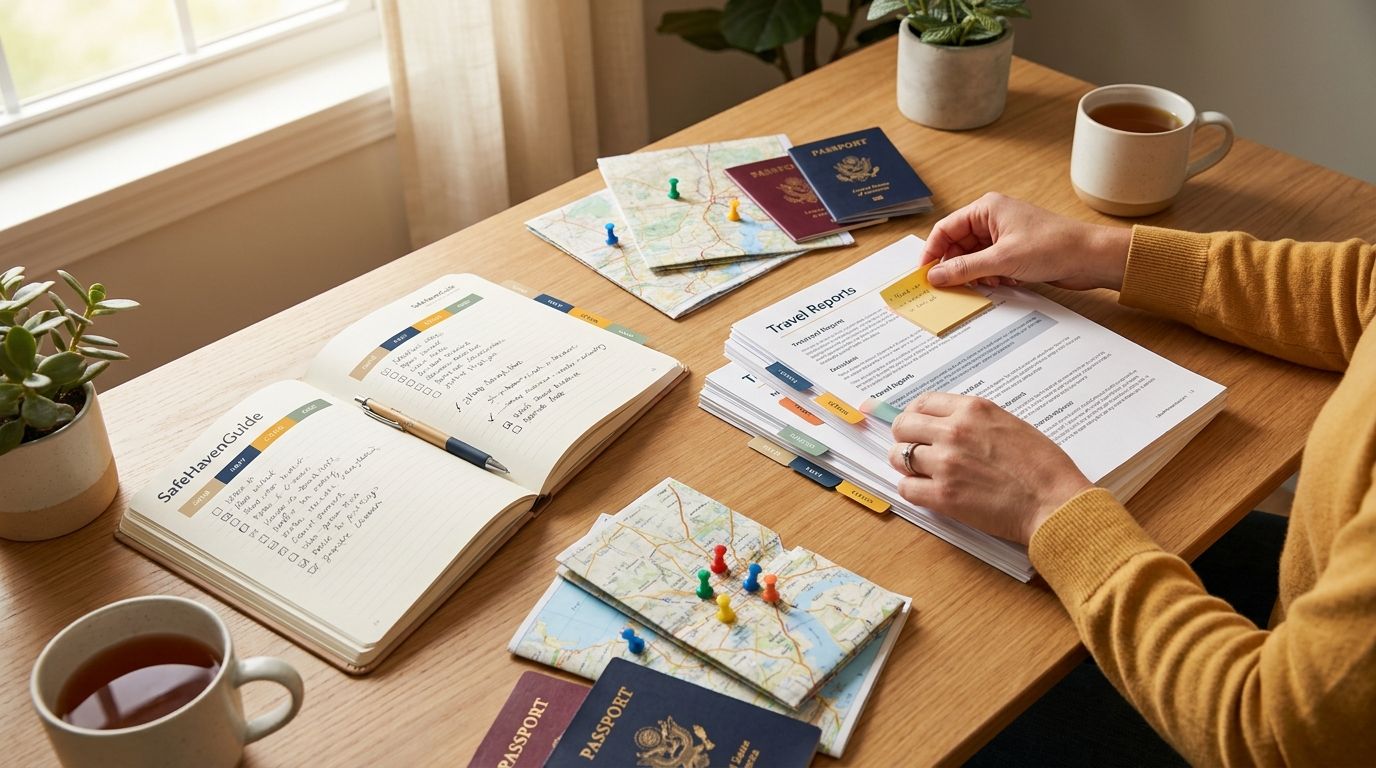
You don't want a giant pile. You want a folder with sections in the same order as your answers.
Organize by question, not by document type
This is the part most people get wrong.
If your folder is sorted by "bank statements, lease, job letter" you still have to scramble to find the right proof under pressure. Instead, sort by what the officer asks.
Example: build a "Funding" section with bank statements and a sponsor letter under one tab. Build a "Housing" section with the lease and the address proof under one tab.
When the officer asks a question, you can confirm what you already know.
Expect interruptions and follow-up questions
A follow-up question is not a trap. It's often a request for a missing detail.
If you don't know an answer, you can say:
- "I want to make sure I give you the correct detail. Can I confirm [X] from my documents?"
That sentence is better than guessing.
Timing and nerves: a simple day-of routine
On the day, don't cram your answers at the last minute. Do a low-effort check:
- Your folder is closed and in order
- Your key dates are written on a single index card
- Your phone is on silent
- You know the address of where you will wait and where you will enter
Then arrive early enough that you're not rushing. Rushing makes people talk faster, and faster talking makes mistakes more likely.
With SafeHavenGuide's adaptive learning system, you can practice your answer structure with scenario prompts so your responses stay consistent even when you're nervous.
Handling common tricky questions with specific scripts
Some questions feel like they come out of nowhere. They usually come from the same concerns: intent, credibility, and eligibility.
Why are you applying from where you are now?
This question often appears when you live abroad from an American perspective.
Good answer pattern:
- "I am currently residing in [country] for [reason]. I applied from my current location because [practical reason tied to your situation]."
Example: applying while living in Japan
You live in Osaka for work. You apply for a visa interview for a move to Canada. The officer asks why you're applying from Japan.
You can say:
- "I am currently employed in Japan and my residence there is documented. My application is based on my plan to move to Canada, and my documents show my current address and status."
Avoid: "I just thought it would be easier."
What will you do if your plans change?
This question tests whether you understand the rules.
Good answer:
- "If there is a change, I will follow the required process for that visa category, including contacting the appropriate office if I need an extension or update."
Avoid: "I'll figure it out when I'm there."
Do you have family in the country you are entering?
Family is not automatically a problem. But it changes your story.
Good answer:
- "Yes, my [relationship] lives in [city]. Their role is [hosting, childcare, support], and my own plan is [your plan]."
Avoid: "They will take care of me."
If you use that phrase, be ready to prove support and explain how it fits the visa rules.
Have you ever overstayed a visa?
If the answer is no, be consistent.
If the answer is yes, you need honesty and a clear explanation. Don't minimize or argue.
A safer script:
- "Yes. It happened in [year] due to [brief reason]. I corrected the situation and I understand the rules now. I am applying with a clear plan that complies with the visa category."
What are your ties to your home country?
Ties questions sound emotional, but the officer wants practical evidence.
Good answer:
- "My ties are [job, family care, property, ongoing obligations]. They are documented in my application."
Avoid: "I love my country." That is not a document.
FAQ
What should I bring to a visa interview if I'm an American living abroad?
Bring the documents that prove your purpose, your housing, and your funding. Also bring the documents that match the most important claims in your application, like your job offer, enrollment letter, or sponsor paperwork. If you had prior refusals, bring a short, organized explanation packet so you can answer clearly.
How do I answer "Why this visa" without sounding like I'm guessing?
Answer the purpose and eligibility match, not your personal feelings. Say which part of your life the visa category is designed for, then reference the proof you already submitted. If you're unsure, pause and confirm the detail from your documents rather than improvising.
What not to say if I'm nervous and I forget a detail?
Do not guess. Do not say you "think" or "maybe" when your application provides a specific date or address. Instead, ask to confirm from your documents, or give a short truthful answer and offer to provide the missing detail.
Is it bad if my plans changed since I submitted the application?
Plans change. The issue is inconsistency. If your plans changed, explain the change calmly and show any updated proof you have. If you can't support the change with documents, you may need to adjust your explanation so it still matches what you applied for.
How long should my answers be in a visa interview?
Aim for 20 to 40 seconds per question. If the officer needs more, they will ask follow-ups. Short answers that reference your paperwork usually sound more credible than long stories.
Next step: build your "question-proof" folder today
Pick the visa category you applied for and list five question categories: purpose, duration, housing, funding, and ties or lawful plan. Then create five tabs in a folder and place one or two key documents under each tab. If you can open the folder and answer each category in one calm paragraph, you're ready for interview day.
Do that today, before you start worrying about what they might ask.
Join the conversation
Subscribe to comment
Join SafeHavenGuide's newsletter to leave a comment and get new posts in your inbox.