
How to turn a SafeHavenGuide country report into your relocation research checklist
Use your SafeHavenGuide country report as a working checklist, not a final verdict. Turn costs, visa routes, housing, and safety details into clear research tasks.
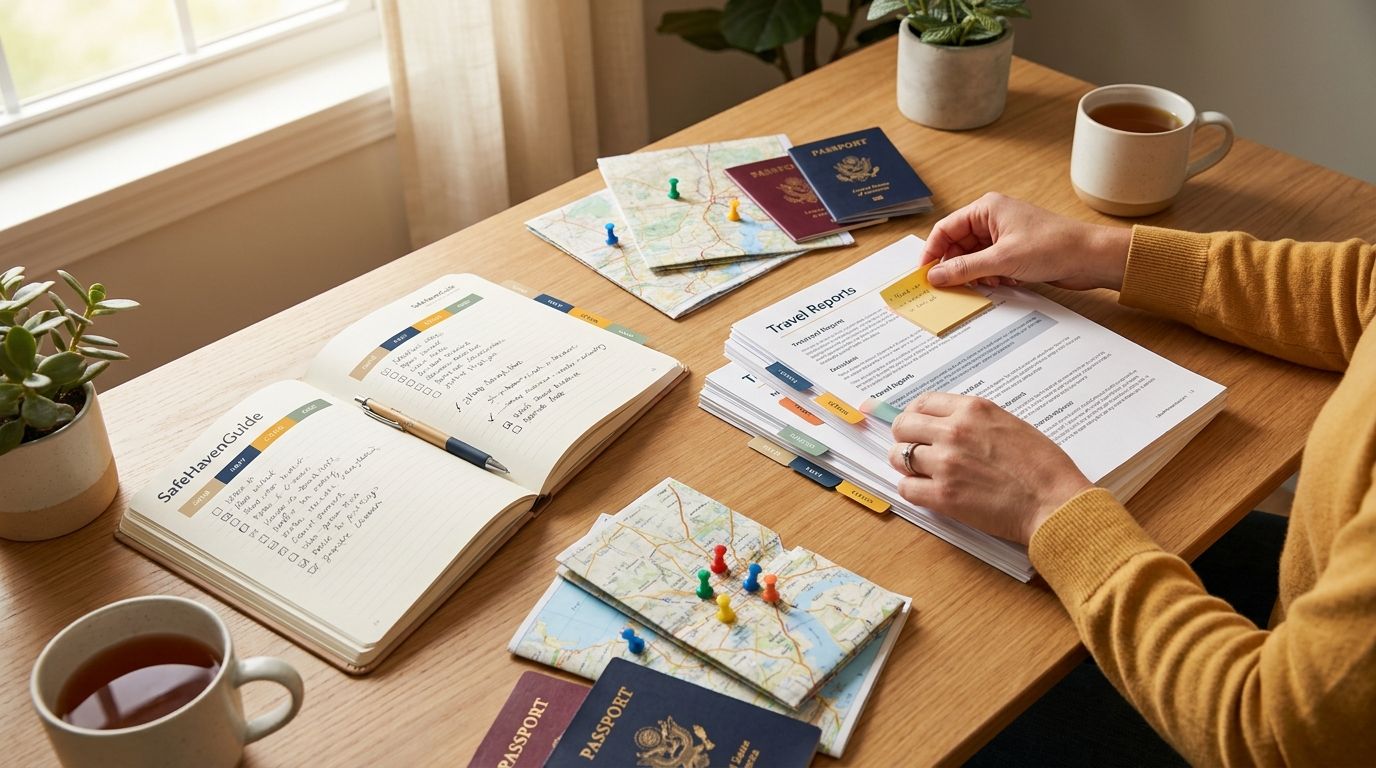
At 9:14 p.m., you're at the kitchen table with a cold cup of coffee, three browser tabs open for Portugal, and the particular dread of someone who has been "researching" for two hours and learned almost nothing useful. One tab shows rent prices. Another explains a visa route in language that seems designed to discourage ordinary people. The third is a forum post from 2021. Technically, you're researching. Mostly, you're collecting anxiety.
A SafeHavenGuide country report gives you a better starting point. To research a country before moving, turn each report section into a question, a source to check, and a task with a deadline. That is how a SafeHavenGuide country report becomes a practical relocation research checklist instead of another document you read once and forget.
The report is not permission to move. It's a map of what you still need to confirm. Use it to test the country against your income, household, visa situation, housing needs, safety concerns, and ordinary Tuesday routine.

Start with the report as a working document
Do not begin by highlighting every attractive detail. That is how a research session turns into a stationery project. Begin by reading the report once without making decisions, then read it again with a pen or a digital note open beside it.
Mark each statement in one of three ways:
- Known: The report gives you a fact that fits your situation, such as an estimated monthly cost or a listed visa route.
- Needs checking: The detail could change by city, household size, income source, or application date.
- Personal question: The report cannot answer it without information about your life, such as whether a neighborhood works for your commute or your child's school needs.
Suppose the report estimates that a couple could spend $3,200 per month in Valencia, Spain. Useful, but not your budget yet. You need to ask whether that figure includes private health insurance, a two-bedroom apartment, utilities during summer, transportation, and a reserve for irregular expenses.
Create a simple table with four columns: report detail, question, source, and next action. A report detail might say that a country offers a residence route for people with remote income. Your question becomes, "Does my income qualify under the current rule, and what proof will I need?" Your next action could be checking the official immigration website and saving the page date.
Use one row for every issue that could change your decision. Ten useful rows will move you farther than a giant list you avoid for three weeks.
The report also helps you separate research from preference. "The city has reliable transit" is a fact to verify. "I want to live somewhere where I can walk to coffee" is a preference to test by looking at actual neighborhoods, prices, and travel times.
Turn cost estimates into your own monthly budget
A country cost figure is a starting point, not a promise. Your relocation research checklist should convert it into a household budget based on the life you expect to live.
Start with the expenses that repeat every month:
- Housing and renters insurance
- Utilities, internet, and mobile service
- Groceries and household supplies
- Local transportation or car costs
- Health insurance and routine care
- School fees, childcare, or eldercare
- Taxes, banking fees, and regular subscriptions
Then add expenses that arrive less often but still hit your cash flow. A visa renewal, annual insurance payment, dental work, new winter clothing, or a flight back to the United States can make a comfortable monthly estimate feel tight fast.
Imagine that Daniel and Priya are considering Porto, Portugal. Their report shows an estimated monthly cost that looks manageable on their combined remote income. When they build their own version, they add a two-bedroom rental outside the center, private insurance, two return flights to Chicago each year, and a monthly amount for Portuguese lessons. Their number is higher than the report figure, but it's more useful because it describes their actual plan.
Use three budget versions:
1. Lean month: The amount you need when you avoid major extras.
2. Normal month: The amount that supports your expected routine.
3. Heavy month: The amount that includes a repair, medical bill, flight, or application expense.
Do not treat the heavy month as a prediction. Treat it as a test. If one large bill would force you onto a credit card, you need a larger cash reserve or a less expensive plan.
Your SafeHavenGuide report can help you compare country costs against your household profile. You still need local checks for rent. Look at listings in the cities you may actually choose, record the date, and note whether the price requires a long lease, a local guarantor, or a substantial deposit. Rent changes faster than most other household costs, so check it again before making a final decision.
Use visa information to build a proof file
A visa section becomes useful when you stop reading it as a description and start treating it as a document plan. Your question is not only, "Can Americans apply?" It is, "Can I prove that I meet this route with documents I can obtain on time?"
For each possible route, record:
- Minimum income or savings requirement
- Acceptable income sources
- Health insurance rules
- Criminal background check requirements
- Birth, marriage, or custody records you may need
- Translation, notarization, and apostille requirements
- Application location and expected processing time
- Renewal conditions after the first approval
The exact rules depend on the country and visa type. Confirm them with the official immigration authority or consulate before you spend money on applications. A third-party article can help you find the right questions, but the government source should settle the current requirement.
Consider Marcus, a freelance software designer in Austin who is looking at Croatia. His report identifies a possible residence route, but the route may require proof of stable income and a specific type of documentation. Marcus should not simply save the visa page. He should create a proof file containing recent tax returns, bank statements, client contracts, health insurance details, and records showing where each document must be certified.
Mark each document with a status:
- Not requested
- Requested
- Received
- Needs certification or translation
- Ready to submit
Check dates carefully. Some background checks and civil documents are accepted only for a limited window. A document can be perfectly genuine and still be too old for the application. That's an irritating distinction, but immigration offices are not known for accepting "the PDF was on my laptop somewhere."
Also record what happens after approval. A route that allows an initial stay may still require an in-country appointment, local registration, a tax number, or a renewal filing. Add each step to your checklist rather than stopping at the word "approved."
Test housing, healthcare, and daily life at city level
Country research can hide major differences between cities. A national rent estimate will not tell you whether you can afford a quiet apartment near a clinic, a train station, or a school. Your checklist should move from country-level information down to two or three specific cities.
For each city, investigate:
- Typical rent for the size and location you need
- Travel time to hospitals, schools, markets, and airports
- Public transit coverage and late-night options
- Neighborhood-level safety information
- Heating, cooling, flood, wildfire, or seasonal weather concerns
- Availability of doctors who serve English-speaking patients
- Lease terms for foreign residents
Take a normal weekday and describe it hour by hour. If you work from home, where will you take calls? If you have children, who handles the 3 p.m. school pickup? If you have a dog, where are the nearby walking routes and what paperwork is required? If you're retired, how far would you travel for a specialist appointment?
Leah and Tom, for instance, are comparing Ljubljana, Slovenia, with Valencia, Spain. Ljubljana may offer a smaller-city rhythm and different housing options. Valencia may offer warmer weather and a larger international community. Neither answer matters until they compare their actual needs: a one-bedroom apartment, regular train access, private medical appointments, and a monthly budget below $3,500.
Use maps and local listings, but do not confuse a map pin with lived convenience. A grocery store 700 meters away may sit across a busy road. A clinic listed as nearby may not accept your insurance. A beautiful apartment may be on a street that goes loud at midnight.
If possible, plan a research visit during an ordinary season, not just during a holiday. Spend one morning buying groceries, taking transit, and locating a pharmacy. The boring errands are often where your decision becomes clearest.
Verify the report with current, named sources
A report gives your research structure. It does not remove the need to verify details that change. Immigration rules, rent, tax treatment, insurance requirements, and public services can all shift between your first search and your actual application.
Build a source log. For every important claim, save:
- The source name
- The web address
- The date you checked it
- The specific rule or figure you found
- The question that remains unanswered
Start with official sources. For visa rules, check the national immigration authority, embassy, or consulate. For tax questions, start with the IRS and the destination country's tax authority. For health coverage, check the insurer and the country's health ministry or public health service.
Use broader research where it helps. The OECD Better Life Index compares housing, health, safety, income, and other measures across countries. The World Bank publishes development and economic indicators. The U.S. Department of State provides country information and travel advisories. These sources answer different questions, so don't use a safety advisory as a substitute for neighborhood research, or a national income figure as a substitute for your rent search.
Suppose your report says healthcare access is strong in a possible destination. Your checklist should ask what "access" means for you specifically. Can you register with a local doctor? How long might a specialist appointment take? Will private insurance exclude a pre-existing condition? What will you pay before reimbursement?
Set a review date for every source that affects your decision. A monthly check may be sensible while you are applying. A quarterly check may be enough while you are still comparing countries. SafeHavenGuide helps you keep your country comparisons and cost assumptions organized, but the source log keeps your evidence visible and dated.
And write down uncertainty. "I have not confirmed whether my freelance income qualifies" is more useful than a confident guess buried somewhere in your notes.
Turn the checklist into a move plan
Research becomes manageable when every open question has an owner, a next action, and a date. Since you are usually the person coordinating the move, make the checklist easy for your future self to use on a tired Tuesday.
Divide your tasks by time:
- This week: Choose two or three countries, read the reports, and list your personal deal-breakers.
- Within 30 days: Check official visa routes, build a household budget, compare city rents, and identify missing documents.
- Within 90 days: Request documents, speak with qualified tax or immigration professionals where needed, and plan a research visit.
- Before applying: Recheck every official rule, confirm document validity, and prepare a cash reserve for fees and delays.
Give each task a finish line you can actually see. "Research healthcare" is too broad. "Find two private insurers, record monthly premiums, and ask whether outpatient specialist care is covered" is a task.
Create a decision gate after each research period. You might continue only if the country meets your minimum income margin, offers a workable visa route, and has at least one city that fits your housing needs. A country can stay interesting without staying on your shortlist. That is not failure, it is the checklist doing its job.
The full SafeHavenGuide ranked shortlist can help you compare countries against budget, family needs, safety, and visa fit. Use that ranking to decide where to spend research time, then use the country reports to surface the questions that need real-world confirmation. You can also save different household scenarios if your plan may change, such as moving alone first or bringing your family immediately.
At the end, your checklist should show three things: what you know, what you still need to verify, and what would make you stop. Keep those categories separate. A relocation plan is much easier to trust when it admits where the gaps are.
FAQ
What is a SafeHavenGuide country report?
A SafeHavenGuide country report organizes information about a potential destination, including cost, visa routes, housing, safety, healthcare, and everyday fit. Use it as a starting document for questions and verification, not as a substitute for official immigration or tax advice.
How do I turn a country report into a relocation research checklist?
Read the report and convert each important detail into a question, source, and next action. Add a deadline and mark whether the item is known, needs checking, or depends on your personal situation.
Which parts of a country report should I verify first?
Verify the visa route, income or savings rules, document requirements, housing costs, health insurance, and tax questions first. These issues can affect whether the move is possible, affordable, or worth pursuing at all.
How many countries should I research at once?
Start with three countries or fewer. A short list gives you enough comparison without spreading your time across too many visa systems, cities, and budgets.
When should I stop researching and choose a country?
Set decision gates based on your non-negotiables, such as a minimum monthly surplus, a workable visa path, acceptable healthcare access, and realistic housing. Choose when the remaining questions are manageable rather than waiting for every uncertainty to disappear.
Open your SafeHavenGuide country report today and create the first ten rows of your checklist. For each row, write one question, one source, and one next action. Then give yourself a date to check the first unanswered item. That small step turns "we should move abroad" into a plan you can actually test.
Join the conversation
Subscribe to comment
Join SafeHavenGuide's newsletter to leave a comment and get new posts in your inbox.