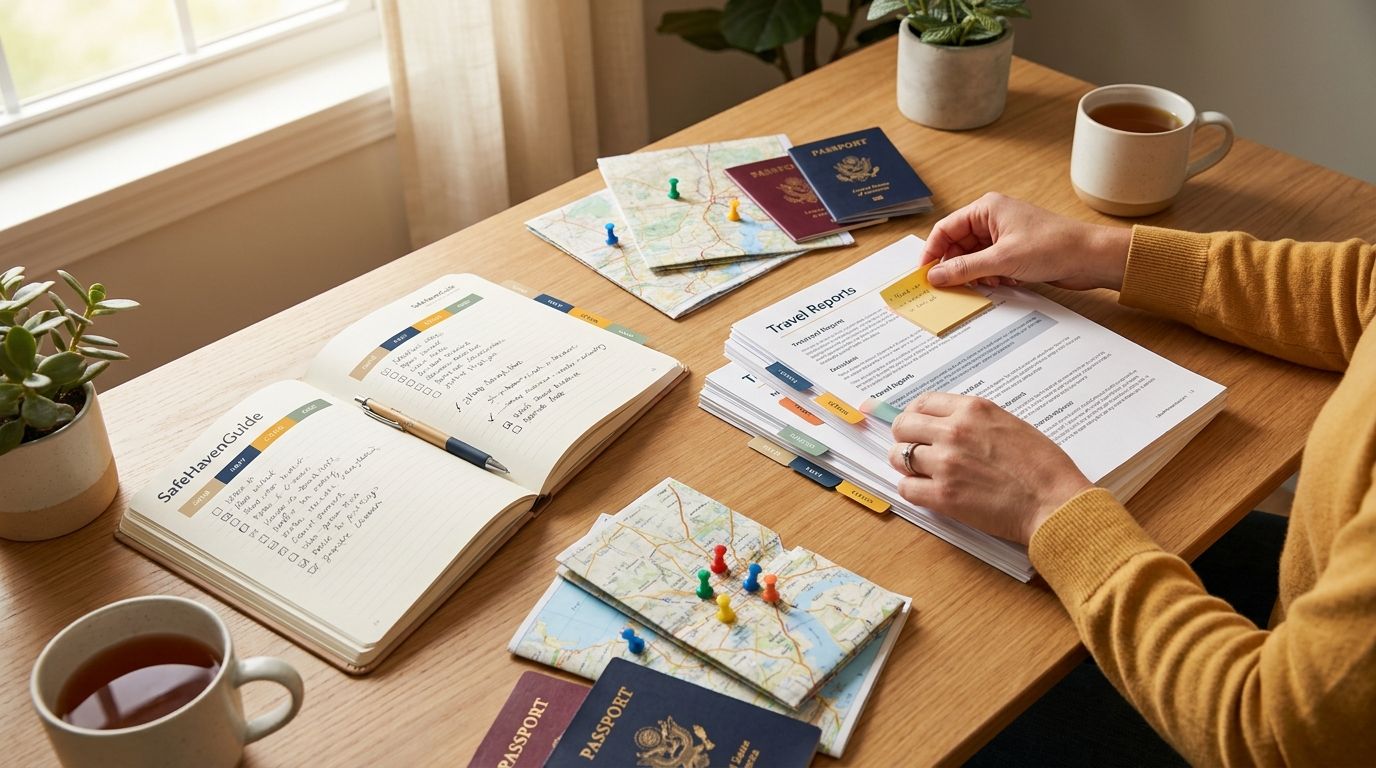
Someday: Japan - A realistic path from “Someday” to “We’re applying”
Japan sounds like a vibe until paperwork shows up. Turn “someday” into an application plan you can actually execute.
You're standing in your kitchen with a half-folded ramen coupon and a sticky note that says "Japan someday." Your browser has been open for weeks. What you need now is a path that turns that fantasy into a move to Japan, with Japan expat visa options you can sort, documents you can gather, and a timeline you can follow.
That is the thesis here: you do not need to "decide later." You need a staged plan that starts with visa fit, then locks in your Japan expat lifestyle expectations, then builds the proof your application will actually ask for.

Section 1: Pick a Japan move frame that matches your life, not your Pinterest board
Japan expat lifestyle planning fails when you build a life that only exists in your head. It works better when you pick a move frame that matches your actual situation today: your job, your studies, your family ties, or a long-term plan that starts with a concrete visa route.
Start here. What is your "reason to be in Japan" that you could explain to a stranger in two sentences? For most Americans, it is work (a job offer or a work-related track), study (language school or a degree program), or family (a spouse or partner and the marriage-based pathways that come with that). If your answer is "I just want to live there," you can still move, but your visa intent will need to connect to something documentable.
Here is a realistic scenario you can copy. In March, Maya Camp starts a spreadsheet called "Japan reasons." She writes down three options:
- Work: She looks for roles that sponsor visas.
- Study: She considers Japanese language school as a bridge.
- Family: She checks whether any relationship-based route applies.
Then she does one hard reality check. She asks, "What proof can I produce in 60 days?" If the answer is "none," that option goes on a slower track. If the answer is "I can gather documents," she keeps it moving.
Why this matters: Japan expat visa options are not interchangeable. You cannot swap a work story for a tourist story and expect the same outcome. You need consistency between your stated purpose and what you can actually show.
Japan's immigration rules are detailed and document-driven, so applications tend to rise or fall on completeness and alignment rather than enthusiasm. That is why your first job is not "book flights." Your first job is matching a visa category to a reason you can document.
Section 2: Build your "Someday to We're Applying" timeline in 4 checkpoints
Most people stall because they treat "apply" as one giant event. Break it into checkpoints instead. Each checkpoint ends with a decision and a list of what you will collect next.
Checkpoint A: Visa fit screen (2-4 weeks)
You gather your basics and decide which Japan expat visa options are even plausible. Review your target category and ask what it requires. For many routes, common requirements include identity documents, proof of qualifications or ties, and financial or sponsor-related proof.
Checkpoint B: Proof inventory (3-6 weeks)
You list every document you will need, then label each one as:
- Already in hand
- Exists but needs updates (renewal, new letter)
- Needs translation or notarization
- Needs a new document (like a work contract or enrollment proof)
Checkpoint C: Application readiness (4-8 weeks)
You confirm formatting, translations, and that your story matches your documents. This is where people mess up by submitting a stack that is technically "real" but not connected to the requirements. Your goal is clarity, not volume.
Checkpoint D: Submission and follow-through
You submit, then track timelines, respond to requests, and keep your records organized.
Here is another concrete scenario. You live in Austin and work in marketing. In May, you decide you want to move to Japan for a job, but you also know you might need a bridge. So you set checkpoint A to identify two tracks: job sponsorship path and language study path to improve your candidacy.
In June, you complete checkpoint B by collecting transcripts, employment letters, and bank statements. You also start Japanese study in a way that creates proof you can show later, like enrollment receipts.
And yes, you will feel a little silly at first making a "proof inventory." That feeling fades when you realize it prevents the last-minute scrambles that derail good plans.
With SafeHavenGuide's adaptive learning system, you can turn this into a structured plan by matching your situation to the document types you will need for your chosen Japan expat visa options. The point is not to guess. The point is to know what you will do next.
Section 3: Turn visa intent into a document story (without over-submitting)
Visa applications are story problems. Your story has to be consistent across your forms, your supporting documents, and your stated purpose.
Start with the core story statement. Write one paragraph that answers three questions: Why Japan, why you now, and how you plan to support yourself.
Then map documents to each sentence. If your story says you are going to work, you need proof that supports employment. If your story says you are studying, you need proof of enrollment or acceptance. If your story says family ties, you need proof of relationship.
Here is the part people skip. They collect documents randomly, then hope the embassy will "connect the dots." Japan's process is not built for guesswork, you are the one connecting the dots.
A practical example: you are targeting a work-related path. You have a resume and a bank account. But you also need documents that show your employment situation and your qualifications. A common mistake is submitting extra travel itineraries when the visa category expects work or qualification proof. That can actually distract from the documents that matter.
So you do this instead:
- You create a "must match" folder for documents that directly support your stated purpose.
- You create an "optional background" folder for items that give context but are not required.
- You only submit what the category asks for.
If you have ever spent an afternoon reorganizing a closet, you know the satisfaction of a clean system. This is that, but with fewer scarves.
For research references, lean on what you can verify in official guidance and widely used government processes. Translation and notarization rules are strict in many US-to-embassy workflows, and Japan-related documentation often requires specific handling. The consistent pattern is: if you do not follow the format rules, your application can get delayed or sent back for correction.
Section 4: Plan your Japan expat lifestyle expectations early, because it affects your visa plan
Japan expat lifestyle is not just rent and ramen. It affects what proof you will need to show you can live there responsibly.
Start with the basics you can estimate now:
- Where you would live (city and neighborhood type)
- How you would get around (train-heavy vs car-dependent)
- What your daily schedule would look like (work hours, study hours, family needs)
- What you would do for healthcare coverage
Then connect those expectations to your visa timeline. If you plan to move for work, your job situation drives your location and your schedule. If you plan to study, your school schedule drives your housing needs and your ability to manage paperwork.
A concrete scenario: you and your partner are both working remotely in the US, and you keep saying "Japan someday." You start looking at visa options and realize remote work alone is not always a clean fit for many categories. So you revise your plan, set checkpoint A again, and explore routes that match your actual purpose, like study or a work-related pathway that aligns with Japan expat visa options.
Another scenario: you are a parent moving to Japan with a child. You are not just planning classrooms. You are planning your childcare schedule, your document timeline, and your ability to prove stability, which means you start earlier on school enrollment questions and healthcare planning.
Even if your visa category does not require every lifestyle detail, your plan should still be realistic. Japan's process tends to reward consistency. When your life plan is coherent, your documents are easier to assemble.
For cost planning, use your estimates as stress tests. If your plan depends on housing that is not realistic for your budget, you will feel it later. That is not a moral failing. It is just math.
Build a monthly budget with housing, transit, healthcare, and basic household spending. Then compare it to your income or savings plan. This step also helps you avoid a common trap: applying with a financial story that falls apart once you price out actual rent in, say, Shibuya versus Saitama.
Section 5: Use "mini-moves" to reduce risk and create proof
You do not have to wait until moving day to start acting like you will live there. Mini-moves help you in three ways: they reduce risk, they create proof, and they make the process feel less like a cliff.
Mini-move ideas that create real documentation:
- Take a Japanese course and save enrollment receipts
- Get a letter from your employer about your role and dates
- Update your resume and save job application logs
- Open a dedicated savings account for your relocation plan
- Gather and organize your US documents early so translation does not become a last-minute emergency
Here is a scenario that sounds small but changes everything. In August, Maya Camp decides she will not "research forever." She picks one mini-move: a structured Japanese course that runs for 12 weeks. She saves receipts and proof of attendance.
Then she uses those receipts to support her visa intent. Even if she later chooses a different visa path, she now has a timeline and proof that she is preparing. Documented preparation is not nothing. It is signal.
You can do the same with work. If your plan includes a work-related route, start aligning your job search with roles that are more likely to support visas. That does not mean you only apply to a fantasy list. It means you track what you did and what you learned.
For families, mini-moves can include researching school enrollment requirements for the city you might live in, then saving screenshots and notes. It also means planning your household logistics so you can move without chaos.
A small note on research: you will find conflicting advice online. Treat official guidance as the source of truth and use community experiences as a reality check. If multiple people mention the same document formatting issue, assume it matters.
Section 6: Common "Someday" delays and how to break them in one week
If you feel stuck, it is usually one of a few problems. Most of them are fixable fast.
Delay 1: You are waiting for certainty
You think you need a perfect job offer, perfect savings, perfect timing. You do not. You need a plan that moves even when uncertainty exists. Pick a visa track, then build proof step by step.
Delay 2: Your documents are scattered
You tell yourself you have everything. Then you search for an old tax transcript or a letter from a previous employer and you start sweating. One week of cleanup fixes this:
- Make a single folder for Japan application documents
- Put your passport, birth certificate, and key records in one place
- Create subfolders for each visa track you are considering
Delay 3: You are over-submitting random items
More is not better. More can create confusion. Stick to what the category asks for.
Delay 4: Your lifestyle plan is vague
You say "Japan expat lifestyle" but you cannot name a city type, an income plan, or a schedule that matches your visa intent. You do not need exact addresses yet. You need coherence.
Delay 5: You are not translating the timeline into action
People say they will "start next month." Then next month becomes "someday." Pick a date and set a task that can be completed by then. For example: "By the 25th, I will have my document list and translation plan."
If you want a simple one-week checklist, use this:
- Day 1: Write your visa intent paragraph
- Day 2: Choose one primary Japan expat visa option and one backup
- Day 3: Create your proof inventory spreadsheet
- Day 4: Start gathering must-match documents
- Day 5: Confirm translation and notarization needs
- Day 6: Draft your application story mapping
- Day 7: Review and adjust
It is boring. It is also effective.
Section 7: When you're ready, submit with confidence and keep your records tight
Once you move from planning into applying, you want fewer surprises. That means you prepare like a person who expects to be asked questions.
Before submission, verify three things:
- Your purpose statement matches your documents
- Your documents are complete and formatted correctly
- Your financial story supports your stated plan
After submission, keep a tracking log. Write down submission date, any reference numbers, and any requests you receive. Also keep digital copies of everything you submitted. If you later need to correct something, you will not waste time rebuilding the package from scratch.
This is also where you handle "what ifs." What if the process takes longer than expected? What if you need updated proof? You can plan for that with your checkpoint system. Your goal is to keep your application story stable and your supporting documents current.
A practical example: you submit in October for a timeline that targets the following year. In November, you may need updated employment letters or updated financial proof. If you planned checkpoint C well, you already know what needs updating and where to get it.
And if you are thinking, "This feels like a lot," you're not wrong. Moving abroad is a project. But it is also a project you can manage when you break it into steps that fit your life.
With SafeHavenGuide's adaptive learning system, you can keep your plan tied to the Japan expat visa options you are actually considering. That reduces the common problem where people gather documents for one track and then switch to another without realizing the mismatch.
FAQ
What are realistic Japan expat visa options for Americans?
Realistic options depend on your situation: work, study, family ties, or other qualifying pathways. Start by matching your reason to be in Japan with the visa category requirements, then build your document story around that purpose.
How do I plan a move to Japan if I do not have a job offer yet?
You can still plan, but expect to use a bridge strategy. Many people focus on study, a visa-compatible work track, or relationship-based pathways depending on eligibility, then they build proof during the bridge period.
What documents do I need for Japan expat visa applications?
Most pathways require identity documents, application forms, and supporting proof aligned to your purpose. You will also need to plan for translation and notarization steps when required, and you should prepare financial or sponsor-related proof when your category asks for it.
How long does it take to go from "someday" to "we're applying"?
For many Americans, a practical range is 2 to 6 months, depending on how quickly you can gather documents and confirm eligibility. If your documents are already organized and your visa fit is clear, you can move faster.
How can SafeHavenGuide help with Japan planning?
SafeHavenGuide helps you structure the decision and document planning so you can move from vague intent to a concrete application plan. You still do the work, but you do it in the right order.
Next step
Pick one visa track you can support with proof in the next 60 days. Then create your proof inventory spreadsheet and write your one-paragraph visa intent statement. If you do those two things this week, "Someday: Japan" turns into "We're applying" before you lose another month to browser tabs.
Join the conversation
Subscribe to comment
Join SafeHavenGuide's newsletter to leave a comment and get new posts in your inbox.