Schengen Visa for Americans: Step-by-Step Application Checklist (Work, Study, Family Visits)
A plain, step-by-step Schengen visa checklist for Americans applying for work, study, or family visits. Less guessing, more receipts.

You're at the kitchen table, printer warming up, folder full of documents that all look slightly wrong. The good news: a Schengen visa application is predictable once you know what to assemble for your specific reason for travel. This guide gives you a step-by-step checklist for work, study, and family visits, plus the common mistakes that slow people down.
And yes, you will probably re-check your dates three times. That is normal. Your future self will thank you.
The Schengen visa basics you must lock in before you gather paperwork
First, decide which Schengen "type" of trip you're applying for. For most Americans, that means a short-stay visa under Schengen rules. The Schengen area lets you travel across multiple countries on one visa, but the application is still country-specific.
Your biggest early decision: which country is your main destination. Usually that's the place where you'll spend the most days, or where your purpose is most clearly focused. Apply to the wrong country and you can end up with delays or a rejection that feels unfair but is still procedural.
Here's the core structure most people follow:
- You apply at the consulate or visa center for the Schengen country that is your main destination.
- You submit a complete application package before travel.
- You prove you have a plan, funds, and a reason that fits your visa category.
A practical example: Sofia is applying from Houston for a 10-day trip to Italy for a short training program, plus 3 days in France to visit a friend. She spends most days in Italy and her training is in Italy, so she applies to Italy.
Another example: Marcus is visiting his sister in Germany for 2 weeks, and also plans 4 days in the Netherlands for sightseeing. Germany is where the lodging and the family connection are, and it's where he spends more days, so Germany is typically the main destination.
Also, check your passport. It should have enough validity for your travel window and enough blank pages. Many rejection letters come down to basic passport details, not your life story.
So before you print anything, write down:
- Your exact travel dates
- Your main destination country
- Your visa category purpose (work, study, family visit)
- Your planned entries into and exits from the Schengen area
That note becomes your anchor for the rest of the checklist.

Step-by-step application checklist (the "always required" documents)
Now you can assemble the package. Most Schengen applications for Americans share a core set of documents, even when the purpose differs.
Use this checklist like a work order. If you can't find something, don't guess. Replace it or stop and fix it.
1) Application form and photo
- Complete the application form for the Schengen country you're applying through.
- Provide a passport photo that matches the country's photo rules (size, background color, and face position).
Common mistake: people submit a photo that's slightly off. Not a dramatic error, but it can trigger an administrative request that eats time.
2) Passport and prior visas
- Your current passport.
- Copies of relevant pages, especially prior visas and stamps.
- Make sure your passport validity and blank pages meet the requirements.
3) Proof of travel plans
- Flight reservations or travel itinerary.
- Proof of lodging for the Schengen stay (hotel bookings, or a letter and proof of where you'll stay if visiting family).
- A detailed day-by-day itinerary helps, especially for study or work-related trips.
4) Travel medical insurance
- Medical insurance that covers expenses in the Schengen area for the duration of your stay.
- Coverage usually needs to be at least €30,000. Most applicants already know this number because it shows up in nearly every checklist.
Insurance is where people get tripped up by coverage gaps. A policy that starts late or ends early can cause real problems.
5) Proof you can support yourself financially
- Bank statements.
- Proof of employment or income.
- Sometimes proof of paid accommodation or sponsorship.
A good rule: your documents should tell a consistent story. If your bank statements suggest you're living on $20 a day but your itinerary puts you in expensive hotels, expect questions.
6) Cover letter and supporting narrative
- A cover letter that explains your purpose, dates, and main destination.
- Keep it factual and easy to scan.
If you're applying for work or study, your cover letter should reference the specific invitation, acceptance letter, or sponsorship documents you're including.
With SafeHavenGuide's adaptive learning system, you can map your trip reason to the document types you're most likely to need, then build a checklist you can reuse for each country you apply to.
Work-related Schengen visa checklist (short stays for training, meetings, and business visits)
Work on paper is not the same as "work" meaning employment in the Schengen country. For short stays, most Americans apply under a business-related purpose like attending meetings, training sessions, conferences, or other short professional activities. The exact label varies by country, but the document logic stays consistent.
What you need to prove for work-related trips
Your application should show that:
- You are not trying to take a job in the country.
- Your activities are temporary.
- You have a clear invitation or confirmation from the hosting organization.
- Your employer supports the trip and you can cover your expenses.
Here's a practical scenario: Jordan is a software engineer in Seattle attending a 5-day training at a partner company in Spain. He has a written invitation letter from the Spanish company, including dates, location, and the training agenda. His employer provides a letter confirming his role, that he will return to the US, and that the company will cover his travel costs.
Another scenario: Priya is traveling to France for a two-day business meeting and a workshop. She is not signing a contract with a French employer. She has meeting confirmations, a letter from her US employer describing the business purpose, and proof of her return plans.
Work-related document checklist
Use this list to make your package coherent:
- Invitation letter from the host organization with your name, dates, location, and purpose.
- Letter from your employer in the US stating your job title, salary or employment status, leave approval, and return expectation.
- Proof of your business relationship if relevant (contract references, partner correspondence, or conference registration).
- Your itinerary that matches the invitation exactly.
- Financial proof (bank statements, and sometimes a sponsor letter if someone else covers costs).
Extra care points
- Your itinerary should not include open-ended items like "working on-site." Replace that with specific meeting times, training sessions, or conference events.
- Your dates must match your invitation and travel reservations. When they don't, your application looks sloppy.
If you've ever had to justify why you're in a meeting calendar invite, you already understand the mindset. The visa office wants that same level of specificity. Vague language costs you time.
Study-related Schengen visa checklist (courses, language programs, and short academic stays)
Studying is one of the most common reasons people apply, especially for short courses. The tricky part: "study" still has to fit a short-stay rule, so your documents must show the program is temporary and your plan is clear.
What you need to prove for study trips
Your application should show:
- You are accepted or enrolled in a specific program.
- The program dates match your travel dates.
- You have a place to stay during the course.
- You have the money to cover fees and living costs.
A concrete example: Elena is applying for a 3-week language course in Portugal. She has an acceptance letter from the school listing the course start and end dates, the address, and the fee breakdown. She also has a schedule showing class times each week. Her US job is flexible for the period, and she submits an employer letter confirming her leave.
Another example: Daniel is taking a short professional certificate course in Germany while working part-time in the US. He submits proof of enrollment, a letter explaining he will complete the program and return to continue his job obligations, and bank statements covering course fees and living costs.
Study-related document checklist
Include:
- Acceptance or enrollment letter from the school or program provider.
- Proof of course fees paid or a clear payment plan.
- Program schedule or course description that matches your itinerary.
- Proof of accommodation.
- Financial proof (bank statements, scholarship letter if applicable, or sponsor documents).
- If you're employed, an employer letter confirming your leave and return.
Common mistakes to avoid
- Submitting an offer email with no dates when the school letter includes dates. Use the letter with the details.
- Writing an itinerary that mentions "research" or "internship" unless your program actually covers it. If it does, your documents should say so explicitly.
- Assuming that "I can study on a visitor visa" is enough. Your application still needs a consistent story with documents.
If you're unsure whether your program is short-stay eligible, check the exact purpose wording used by the consulate you apply through. The paper trail should match the category.
Family visit Schengen visa checklist (visiting relatives and friends)
Family visit applications are often the most straightforward, but they still need structure. The visa office wants to know who you're visiting, where you'll stay, and that the connection is genuine.
What you need to prove for family visits
Your application should show:
- Your relationship to the host (family ties or close personal connection, depending on the country's rules).
- The host's legal status in the Schengen country (citizenship or residence status).
- That you have a place to stay and a plan for your visit.
- That you can cover your expenses, or that the host is sponsoring you.
Here's how it looks in real life: Carlos is visiting his aunt in the Netherlands for 12 days. He has a letter from his aunt explaining the trip dates, where he will stay, and that she will cover lodging. He includes her Dutch residence card and a copy of her passport bio page if required, plus his own bank statements and a simple itinerary.
Another example: Mei is visiting a friend in Spain for a week. She has an invitation letter, proof the friend lives in Spain legally, and the friend's address details. She also includes financial proof to cover her own expenses, because some countries expect visitors to demonstrate they can support themselves even when someone is hosting them.
Family visit document checklist
Include:
- Invitation letter from the host.
- Proof of relationship (birth certificates, marriage certificates, or other documents the country accepts).
- Host's passport or ID and proof of legal residence status.
- Proof of accommodation (often the invitation letter plus address details).
- Your itinerary and travel dates.
- Financial proof (bank statements) and, if applicable, a sponsor letter.
Translation and copy discipline
If documents are not in an accepted language, you may need certified translations. Submit clear copies. A blurry scan that cuts off an address is exactly the kind of problem that triggers extra back-and-forth.
Family visit applications work best when the package reads like one story. Relationship, dates, lodging, and finances should all line up.
Visa application timeline, submission strategy, and rejection-proofing
You can have perfect documents and still lose time if you submit at the wrong moment or with avoidable errors. Treat the timeline like part of the checklist.
Plan your submission window
Many Schengen countries accept applications up to 3 months before travel. Some visa centers have different cutoffs for peak seasons. Check the specific country's portal or the visa application center website for the exact submission rules.
If you're applying for a work-related trip with a host invitation, align your application timing with when your invitation letter is valid and when your travel reservations can be confirmed.
Use a "consistency audit" before you submit
Do this on the day you print or upload your final package. It takes 20 minutes and saves weeks.
Check:
- Dates: application dates match travel reservations and invitation letters.
- Main destination: your itinerary shows the most days in the country you applied to.
- Address consistency: your accommodation address matches your invitation and itinerary.
- Insurance coverage: policy dates cover the whole Schengen stay.
- Financial story: bank statements match your claimed expenses.
Here's a quick example: Aisha is applying for a study course in Austria but books a hotel there for only part of the trip and stays with a friend for the rest. Her itinerary says "course each day," but her accommodation proof shows she's in another city during class days. Even if the course schedule is real, the package looks inconsistent.
Understand what "missing document" looks like
Most rejection or delay reasons fall into patterns:
- Missing proof of accommodation.
- Insurance that does not cover the entire stay.
- Invitation letter missing key details like dates or address.
- Passport validity issues.
- Financial proof that is too thin for the itinerary.
You can't control every decision. But you can control how complete and consistent your file is.
Keep copies and track everything
Create a simple folder structure:
- Application form
- Passport and prior visas
- Insurance
- Financial proof
- Purpose-specific documents (work, study, family)
- Travel itinerary and lodging
Save the submission confirmation and any correspondence. If you need to respond to a request for additional information, you'll know exactly what you already provided.
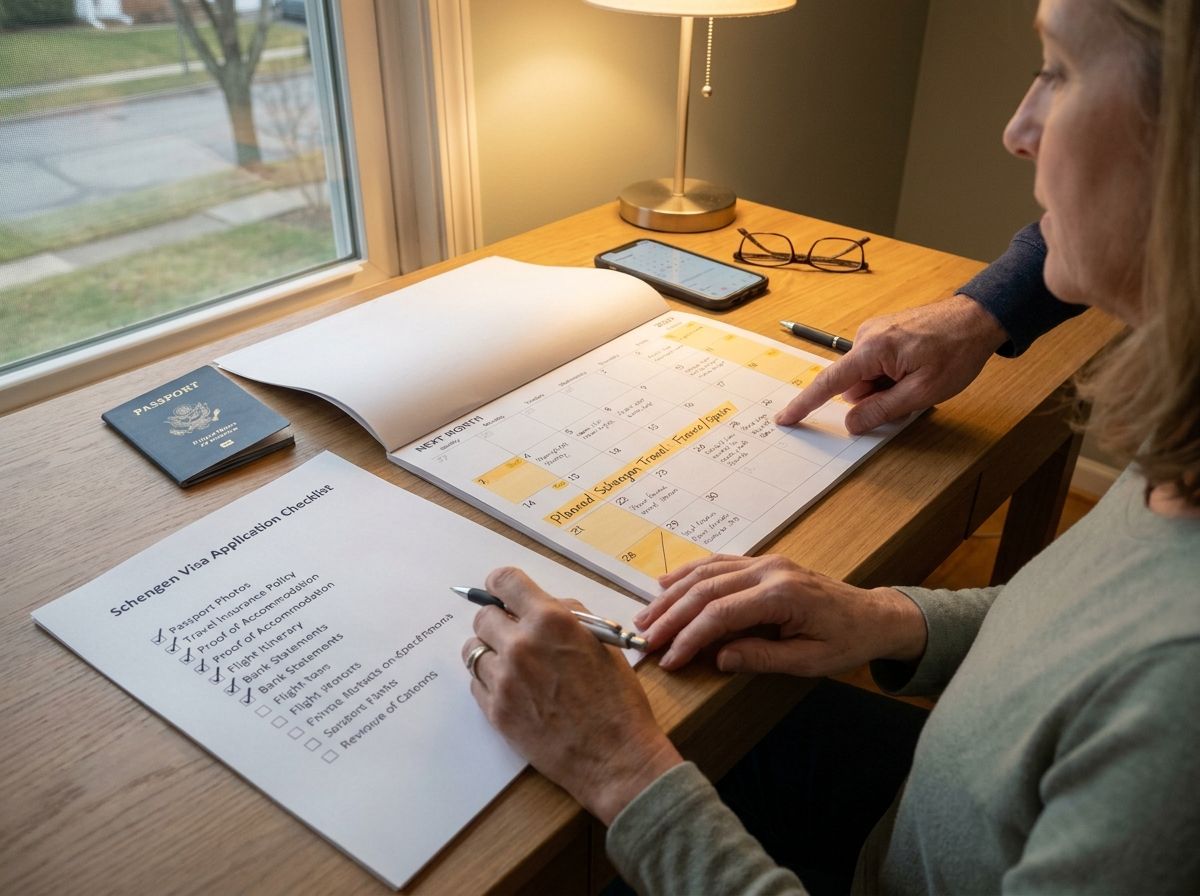
How to tailor the checklist to your specific situation (3 quick scenarios)
Use the sections above as your base. Then tailor to the details that tend to trigger questions.
Scenario 1: Work training in Spain with a US employer letter
Name: Jordan (Seattle)
Moment: He is filling in the itinerary and realizes his flight arrives one day later than the training start date listed in the invitation.
Action:
- Update the travel reservations to match the training dates, or ask the host to confirm the correct start date.
- Use the employer letter to confirm leave dates and return expectation.
- Make sure your itinerary lists training sessions with the same dates as the invitation.
Scenario 2: Language course in Portugal with paid fees
Name: Elena (Boston)
Moment: She has an email receipt but the school letter includes a full fee breakdown.
Action:
- Use the school letter with dates and fee details.
- Provide proof of accommodation for the entire course period.
- Include bank statements that support both course fees and living costs.
Scenario 3: Family visit in the Netherlands with a host invitation
Name: Carlos (Chicago)
Moment: He submits an invitation letter but it does not include his aunt's address.
Action:
- Ask the host to provide the full address and the exact dates of the visit.
- Include proof of legal residence status for the host.
- Provide financial proof to cover your expenses unless the host's sponsor letter explicitly covers them.
These scenarios share a theme: your documents must fit together like a set of matching pages from the same book.
And yes, you can absolutely be the person who over-prepares. Not a crime.
FAQ
What is the main destination rule for a Schengen visa, and how do I apply it?
The main destination is the Schengen country where you will spend the most days, or where your trip purpose is strongest. You should apply to the consulate or visa center for that country. If your days and purpose split evenly, follow the guidance of the specific country you're applying through.
What medical insurance coverage do I need for a Schengen visa?
Most Schengen applications require travel medical insurance that covers you throughout your stay in the Schengen area. Coverage is commonly at least €30,000. Your policy dates must match your travel dates, not just your month.
Do I need an employer letter for work-related Schengen applications?
Often, yes. For short work-related activities like training or business meetings, consulates typically expect proof you are employed and that you will return to your home country after the trip. Your employer letter should include your job title, leave approval, and return expectation.
What documents do I need for a family visit Schengen visa?
You typically need an invitation letter from the host, proof of your relationship, the host's legal status in the country, and proof of accommodation. You also need your own itinerary and financial proof, unless the host provides a clear sponsorship letter that covers costs.
How long before travel should I apply for a Schengen visa?
Many applications can be submitted up to 3 months before travel, but exact rules vary by country and visa center. Start by checking the specific country's application portal and plan backward from your planned travel date.
Next step: build your document folder before you start filling forms
Pick your main destination country and write your exact travel dates today. Then create your folder structure and start with the purpose-specific items: invitation letter, enrollment letter, or family invitation plus relationship proof. Once those are in place, complete the application form and run the consistency audit before you submit.
Join the conversation
Subscribe to comment
Join SafeHavenGuide's newsletter to leave a comment and get new posts in your inbox.