
Rent Reality Check Abroad: How to Budget for Deposit, Utilities, Internet, and Hidden Move-In Fees
The first rent payment is rarely the biggest surprise. This guide helps you budget the deposit, utilities, internet, and move-in fees so month one does not drain your savings.

You open the lease email, see the monthly rent number, and feel good for about 30 seconds. Then you reread the fine print and realize you also need a security deposit, a utility setup fee, internet installation, and a stack of "move-in" charges that never showed up in the rent quote.
The fix is straightforward: budget for every dollar you pay before you ever get the keys, budget for utilities and internet that start slower than you expect, and budget for the fees landlords treat like "common practice." Do that math up front, and your move abroad feels like a plan instead of a surprise bill parade.
The thesis: your first month is really your first cash event
The rent number is the headline. Your cash flow is the story.
When you move abroad, "rent" is often only one part of the total move-in cost. Many leases require a security deposit (sometimes called a bond, guarantee, or deposit), sometimes plus a separate move-in fee or administrative fee. Utilities and internet may require deposits or activation charges, and some countries bill utilities in ways that look nothing like what you're used to back home.
Here is the core budgeting idea you can use in any country:
- Add every required payment that happens before or at key handover.
- Estimate your first 30 days of utilities and internet based on how local billing actually works, not on what you paid in your last US apartment.
- Keep a buffer for "paperwork fees" and "maintenance or building services" that show up even when the unit looks move-in ready.
Because yes, you will still have the monthly rent. But the deposit and move-in charges can be the difference between "we planned for it" and "we put it on a credit card and prayed." (You can laugh now. You will not laugh later if you skip this.)
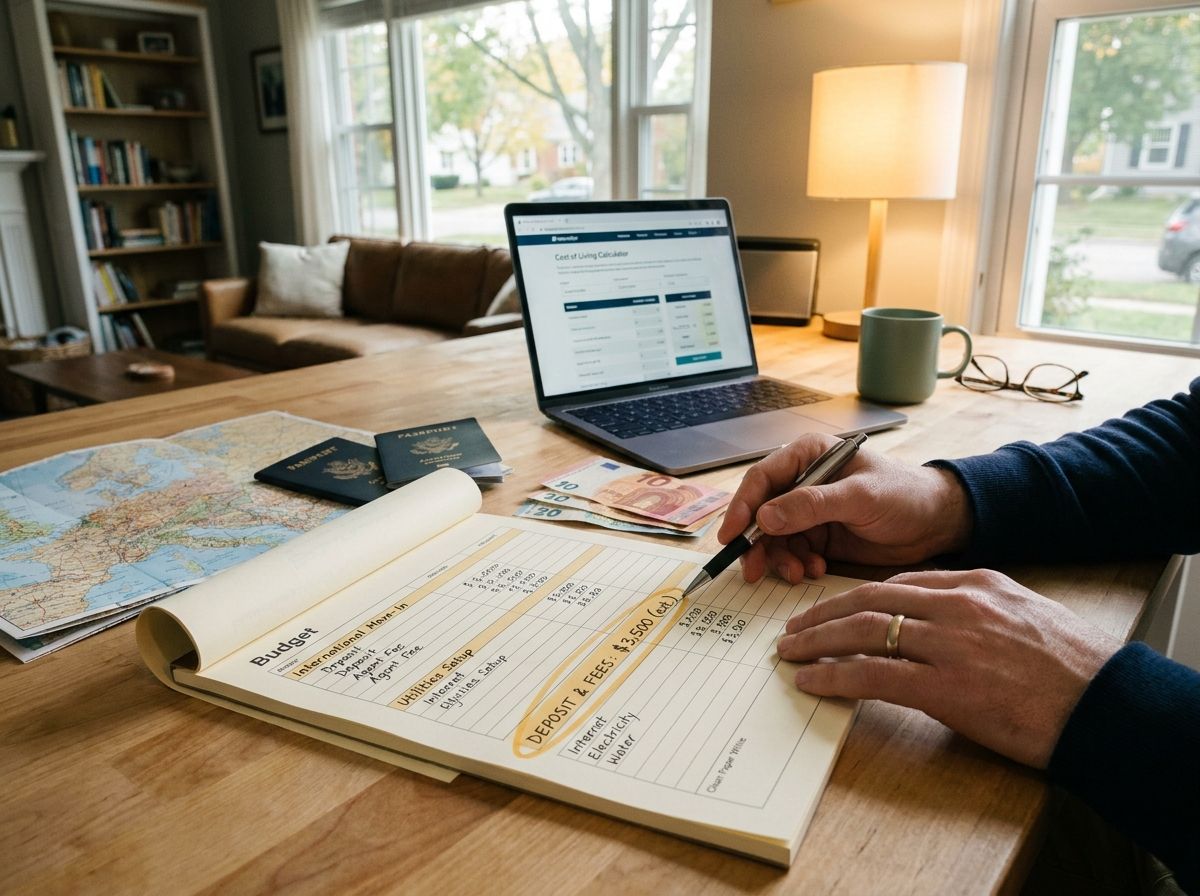
What to budget for before you sign (deposit, guarantees, and admin fees)
Before you sign anything, you want a line-by-line view of what you pay at move-in. Not "about" what you pay. You need the numbers.
Security deposits abroad can be one month's rent, two months, or a fixed amount. Some places also require a guarantee, bank letter, or landlord-backed insurance. Even when the deposit is "refundable," treat it as money tied up for months after you move out while the landlord works through inspections and paperwork.
Also watch for fees that sound small but stack up:
- Admin fee for the lease agreement or contract registration
- Move-in or handover fee
- Building management fee (sometimes one-time)
- Key deposit or access card deposit
- Cleaning fee if the unit is not professionally cleaned
A practical move: ask the landlord or agent for a "move-in statement" listing every due amount at signing and at key handover. If they cannot provide it, ask for the total amount paid at move-in, then ask what each part is called.
Example 1: Lisbon, Portugal apartment rental with a "deposit + admin" surprise
Megan and her partner toured a two-bedroom in Lisbon. The listing said "rent: €1,650/month." The agent said the deposit was "one month." That sounded straightforward.
Then they asked for the move-in statement. The deposit was €1,650, but there was also a lease admin fee of €250 and a one-time building service charge of €120. Their first cash outlay was €1,650 (deposit) + €1,650 (first month) + €250 + €120, before utilities and internet even started. That is €3,670 before they bought a single bed sheet.
Example 2: Barcelona, Spain with a deposit that is not the only "guarantee"
In Barcelona, a friend rented a studio where the deposit was one month. But the landlord also required a "guarantee" process through a local system, plus an additional paperwork fee. The agent described it like a formality, and technically it was, but it was not included in the deposit line. The friend budgeted for one month's deposit and got hit with an extra €400 in move-in processing costs. Their month-one budget was off by a quarter.
Example 3: Berlin, Germany and the difference between deposit and "Kaution" timing
In Berlin, many leases require a security deposit called Kaution. It can be held until move-out. What caught one renter off guard was the timing. They paid the Kaution at move-in, but the unit also required initial utility setup fees and a new internet contract activation. They had planned for "Kaution + first rent" and never accounted for the startup fees that arrived in the first two weeks.
What you can do right now
When you request a quote, ask these questions in plain language:
- "What is the security deposit amount and how is it paid back?"
- "What fees are due at signing versus at key handover?"
- "Is there a building management fee or one-time service fee?"
If the agent answers vaguely, slow down and get a written breakdown.
Utilities abroad: budget for setup, billing style, and the first 30 days
Utilities budgeting is where people get burned because local billing is not "US simple." Some countries bill utilities differently by season. Some include utilities in the rent. Some split electricity, gas, water, and building heating into separate accounts. Some require a deposit just to open a utility account.
Start by identifying what utilities exist in your unit:
- Electricity
- Gas (often for heating or hot water)
- Water
- Heating (sometimes separate)
- Trash or building waste (sometimes separate)
Then ask how billing works:
- Is it included in rent?
- Is it billed monthly or estimated with annual reconciliation?
- Are there meter readings or estimated bills?
A common pattern is estimated bills followed by a later "true-up." Your monthly cost looks low at first, then an unexpected charge arrives. Build a yearly average into your monthly budget and that surprise shrinks considerably.
A simple utilities budgeting method (works almost anywhere)
Use this approach:
1) Get the last tenant's utility costs if possible.
2) If you cannot, estimate using typical consumption for your unit size and household habits.
3) Add a startup buffer for activation fees and any utility deposits.
You are not trying to be perfect. You are trying to avoid the "we had no idea" moment.
Example 4: A winter heating hit in Montreal, Canada (billing shock is not only a Europe problem)
Even though this post focuses on moving abroad, the same utility logic applies in North America outside the US. A family moving to Montreal budgeted for electricity but forgot that heating costs were billed separately and ran much higher through winter. Their first two months were manageable. Then a seasonal reconciliation arrived with a charge that felt like it came from nowhere. No winter buffer. Real pain.
Utilities are seasonal in many places. You plan for that.
Setup fees and deposits you might see
Depending on the country and utility provider, you may see:
- Account activation fee
- Utility meter inspection fee
- Utility deposit (less common now, but still possible)
- First bill that includes "catch-up" charges
One rule of thumb worth keeping: assume your first utility month is not typical. It includes setup friction and sometimes estimated billing catch-up.
Internet abroad: activation fees, contract timing, and "it starts late" reality
Internet is another category where your first month rarely matches the advertised monthly plan. Installation can take days or weeks. The provider may charge an activation or installation fee. Some places require a longer contract term, and you might need to pay for equipment or router rental.
So how do you budget without guessing?
Ask these questions before you sign a lease
- "Can the unit already support internet and what providers serve the building?"
- "Will installation require a technician visit?"
- "Is there an installation or activation fee?"
- "What is the earliest installation date?"
If the landlord says "the previous tenant had internet," that does not guarantee you will. Buildings can have wiring that works, but contracts and access points still need setup.
Example 5: Remote work and the "no internet for two weeks" moment
A remote worker moving to Amsterdam scheduled internet right after signing. The provider said installation would happen "soon." Soon meant 12 days. They still paid rent, but their workdays depended on a hotspot and occasional coworking sessions. They had budgeted the monthly internet cost, but not the temporary workaround costs. That gap ran about €250 more than expected.
This is why you budget for internet timing.
Budget line items for internet
At minimum, plan for:
- Monthly internet cost
- Possible activation/installation fee
- Equipment fee or router rental
- A buffer for temporary backup (mobile hotspot, coworking, or an extra data plan)
If you are moving as a family, also plan for streaming and school needs. "We can survive without internet for a few days" becomes "why is the homework portal down" fast.
Hidden move-in fees that people forget (and how to spot them)
Hidden fees are not always hidden. They are just easy to miss when you are focused on rent.
These are the ones that show up most often in real moves:
1) Building services and common area charges
Some buildings charge one-time move-in fees for common areas, elevator access, or building management processing. Sometimes it is called "move-in service," "building fee," or "administration."
2) Cleaning or inspection fees
Some leases require professional cleaning before move-out. Sometimes you pay a cleaning fee at move-in if the unit is not fully cleaned to standard.
3) Parking, storage, or access fees
Parking spots and storage units are often separate from rent. Access cards, fobs, and keys can require their own deposits.
4) Insurance that is not optional
In some places, tenant insurance or building insurance that covers certain risks is required by the lease, even if it never appeared in the rent listing.
5) Utility-related fees
Utility setup can include inspection, meter activation, or administrative fees.
How to spot them in the lease language
You do not need to become a lawyer. You need to recognize patterns.
Look for words like:
- deposit, bond, guarantee, Kaution
- admin fee, agency fee, contract fee
- service fee, building fee, common area
- handover fee, key fee
- cleaning fee, inspection fee
- utilities, charges, "included" vs "not included"
If a line item is confusing, ask for a translation or a plain-language explanation. If you are working with SafeHavenGuide's adaptive learning system, you can build a checklist of common move-in charges for your destination so you do not miss the same category twice.
A budgeting worksheet you can use today (numbers you can fill)
You need a structure you can repeat for every rental. Here is a practical worksheet format you can copy into your notes.
Step 1: Move-in cash total (before you get comfortable)
Add these together:
- First month rent
- Security deposit (and any guarantee or bond requirement)
- Lease admin fee(s)
- Move-in or handover fee(s)
- Key/access card deposit(s)
- Any one-time cleaning or inspection fee
Step 2: Setup costs in your first two weeks
Add these together:
- Utility activation or deposit
- Internet installation/activation fee
- Router or equipment fee
- Temporary internet backup (hotspot or coworking buffer)
Step 3: First 30 days of running costs
Add these together:
- Utilities estimate for the first month
- Internet monthly cost (even if partial month, budget for it)
- Renter's insurance (if required)
- Any building monthly service charge (if separate from rent)
Step 4: Buffer
Add a buffer of 10% to 20% of your move-in cash total. If your move is in a peak season or you are renting short-term first, increase it.
That buffer is not a luxury. It covers invoice timing, partial billing, and the "we need a deposit for this service too" moment.
Country differences that change your deposit and utility math
You do not need to memorize every country's rental customs. You need to know which categories change.
Deposit sizes and payment expectations
Some places expect a larger upfront deposit relative to monthly rent. Others use smaller deposits but require extra processing fees. Your job is to ask for the full move-in statement and convert it into your own "cash event" number.
Utilities included in rent vs billed separately
In some rentals, utilities are included with a flat amount. In others, you pay separately and may face an annual reconciliation. Your budgeting should match the local billing style, not the US model you already know.
Internet contract norms
In some places, you can start internet with minimal friction. In others, installation scheduling is slow and contract terms are longer. Budget for a backup plan if installation timing shifts.
A realistic target: your first month should not exceed your "planned cash"
Set a personal rule if you can: your total move-in cash should be covered by savings you set aside specifically for the move. If it exceeds that, you adjust before you sign.
This is where a lot of people lose control. They sign and then scramble. Scrambling is expensive.
FAQ
How much should I budget for a security deposit when renting abroad?
Most rentals require a security deposit based on a monthly rent amount or a fixed local amount. The safe move is to budget for the deposit plus any separate guarantee or admin fee, then treat the deposit as money you do not get back quickly. Ask for a move-in statement so you see every deposit-like payment.
Are utilities and internet included in rent abroad?
Sometimes they are, but many times they are billed separately. Even when utilities are "included," there can still be building charges or a reconciliation at the end of the year. Ask what exactly is included and how the building handles heating and water.
Why is my first utilities bill so high abroad?
It is often a billing timing issue. You may pay estimated bills first, then receive a later reconciliation. You can also see setup charges or higher consumption during the first month if you move during a colder or hotter season.
What hidden fees should I ask about before moving into a rental?
Ask about lease admin fees, move-in or handover fees, key or access card deposits, building services, and any cleaning or inspection fees. Also ask whether renter's insurance is required and whether parking or storage carries separate charges.
How do I budget for internet installation delays?
Assume installation can take longer than the provider's website says. Budget for a temporary backup like a mobile hotspot or short-term coworking access, and ask for the earliest installation date before you sign your internet contract.
Your next step: request the move-in statement and build your cash event number
Pick your next rental and request a move-in statement in writing. Then add the numbers into the worksheet: first month rent, deposit and any guarantee, admin and move-in fees, utility and internet setup costs, and a 10% to 20% buffer.
Do this once, and you will stop guessing. You will know your cash event number before you sign, which means you can plan the rest of the move without the month-one panic.
Join the conversation
Subscribe to comment
Join SafeHavenGuide's newsletter to leave a comment and get new posts in your inbox.