Portugal vs. France for American expats: cost, healthcare, safety, and residency
Portugal or France? Compare realistic living costs, healthcare access, safety, taxes, and residency routes before choosing your next country.

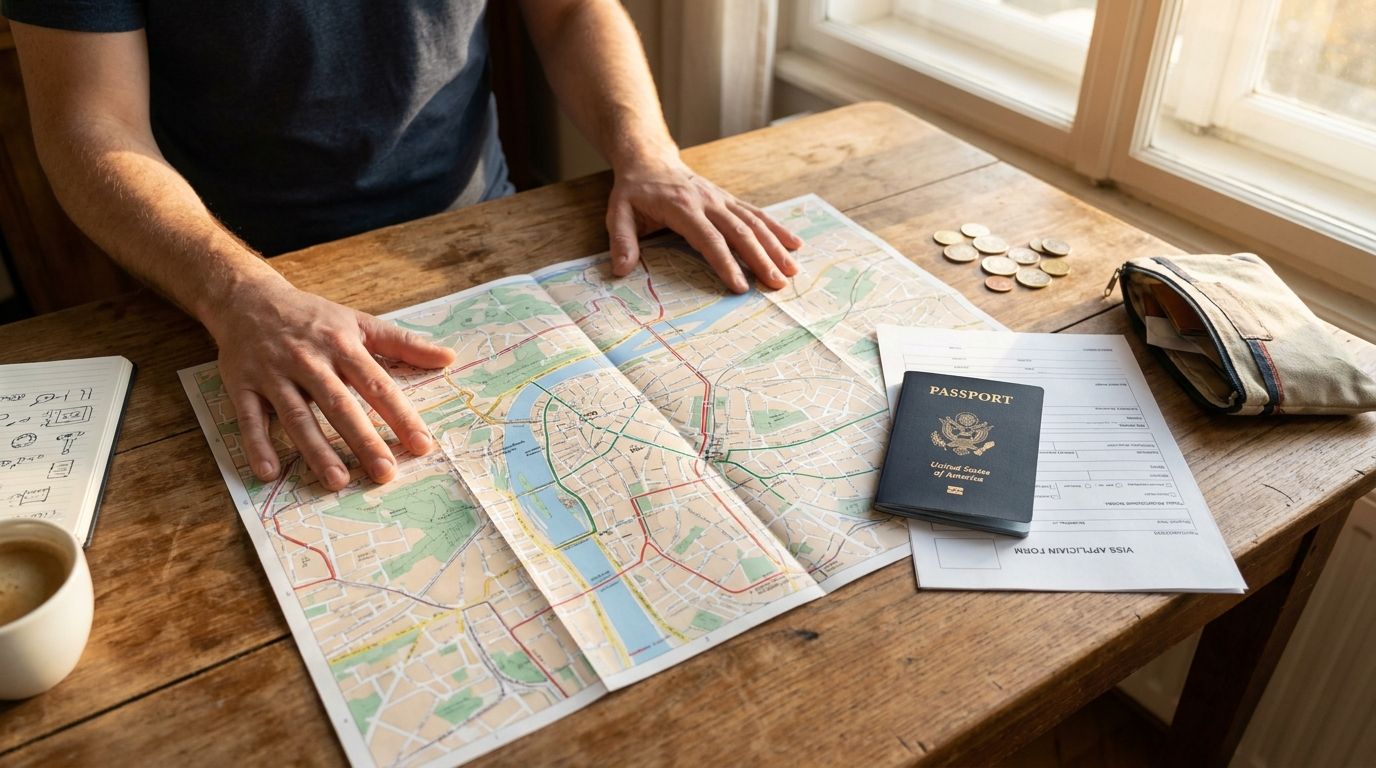
At 7:15 on a Tuesday morning, you're standing in a rented kitchen in Porto or Lyon, comparing a €1,200 rent payment with the monthly budget you scratched on the back of an envelope. Portugal and France can both offer a good life for Americans, but they suit different budgets, healthcare needs, work plans, and tolerance for paperwork. For many retirees and remote workers, Portugal is the easier financial fit. France often makes more sense if you want stronger public services, larger cities, or a more established healthcare system and can absorb higher monthly costs.
Short answer: Portugal usually costs less, has a simpler first-year budget, and offers a clear residence visa route for people with passive income or remote work. France usually offers broader public infrastructure and a deeper healthcare network, but its housing, taxes, and administrative requirements can be heavier. The best country for American expats depends less on holiday impressions and more on your household income, city choice, health needs, and visa plan.That distinction matters because a move is not a two-week test of pastries and sunshine. It is rent renewal, prescription refills, tax forms, grocery prices, and the Tuesday when your washing machine breaks. Your preferred country needs to work on that Tuesday.

Portugal vs France for expats: the practical difference
Portugal is often the gentler starting point for an American household trying to lower its monthly spending without leaving Western Europe. Outside central Lisbon, central Porto, and the Algarve's most popular towns, rents are still more manageable. Public transport is useful in the larger cities, groceries are often less expensive than in France, and many everyday services cost less.
France has a wider range of places to live. You can choose Paris, a regional city such as Lyon or Nantes, a smaller town, or a rural area with a train connection. That range gives you more options, but the budget shifts sharply by location. A couple who cannot make Paris work might be comfortable in Limoges, Clermont-Ferrand, or Angers.
Portugal is smaller and easier to navigate geographically. You can reach much of the country in a day by train or car, though rail service varies. France has more regional variety and stronger intercity rail connections, but distances can affect how often you visit family, reach an airport, or see a specialist.
A useful comparison starts with the life you will actually lead:
- If you need lower rent outside the biggest cities, Portugal often has the advantage.
- If you need access to many regional job markets, France gives you more choices.
- If you want mild winters and a smaller country, Portugal may feel easier.
- If you want dense rail links, major hospitals, and larger cultural institutions, France may fit better.
Do not compare Lisbon with all of France. Compare the exact places you could afford. Lisbon against Paris creates a dramatic number. Porto against Lyon gives you a more useful decision. Braga against Nantes may tell you even more.
Portugal and France cost of living: what your monthly budget may look like
Cost of living comparisons between Portugal and France often lean on national averages, but your rent will decide whether the move feels comfortable. Eurostat's 2024 household consumption price data placed France above the European Union average and Portugal below it, though national figures hide the gap between a capital city and a smaller town. Treat that data as direction, not as your personal forecast.
For a single person renting a modest one-bedroom apartment outside the most expensive central districts, a rough 2026 planning range is €1,600 to €2,500 per month in Portugal and €1,900 to €3,000 in France. A couple may plan for €2,300 to €3,600 in Portugal and €2,700 to €4,200 in France. These figures assume ordinary housing, groceries, utilities, local transport, private health coverage during the early residence period, and some eating out. They do not include major travel, private school tuition, or a mortgage.
The biggest variables are obvious once you put them on paper:
- Housing: Lisbon, Porto, Paris, Nice, and Bordeaux can absorb a large share of income.
- Utilities: Heating needs can raise winter costs in northern Portugal and much of France.
- Transport: A car can change a small-town budget by several hundred euros per month.
- Healthcare: Private insurance may be temporary, supplemental, or necessary for certain treatments.
- Taxes: Your US filing duties do not disappear when you become a resident elsewhere.
Consider a real planning example. Suppose David and Priya have $5,500 in monthly retirement income and want a two-bedroom apartment. In Coimbra, they might build a workable budget around €2,700 before international travel and tax planning. In Lyon, the same household could need closer to €3,500, especially if they want a central apartment and frequent rail trips.
That does not make Portugal automatically cheap. Rents in popular Portuguese neighborhoods rose sharply over the past decade, and local wages are lower than in France. You may save on rent and lose some of that advantage if you import a US-style car habit, rely on international schools, or insist on a short-term furnished lease.
Before you choose, create two budgets with the same assumptions. Use twelve months of rent, not a one-month promotional rate. Add deposits, agency fees, insurance, furniture, residence appointments, and two trips back to the United States. Your first-year cost is the number that deserves your attention.
Healthcare in Portugal and France
Both countries use public healthcare systems, but the way you enter them matters. In Portugal, legal residents can generally register with the Serviço Nacional de Saúde, known as the SNS, and receive a user number. Access depends on registration, local capacity, and the services available in your area. Many Americans also buy private insurance for faster specialist appointments or private hospital access.
France uses Assurance Maladie, the public health insurance system. A resident usually applies for affiliation through the appropriate administrative process and receives a social security number and health card after approval. New residents can face a waiting period or a temporary coverage arrangement depending on their status, so you should not cancel American coverage until your French access is confirmed.
France has a strong reputation for hospital and specialist care, and the World Health Organization's widely cited health system comparison placed France near the top in its 2000 assessment. That report is old, so treat it as historical context rather than a current scorecard. Care still varies by region, doctor availability, appointment delays, and whether you can communicate comfortably with the provider.
Portugal's private system is often attractive to Americans during the transition. A private consultation in a major city may cost less than a similar appointment in the United States, but prices vary by provider and specialty. Rural areas may offer fewer English-speaking doctors and fewer specialist choices.
Plan your healthcare move around your actual needs:
- Bring a complete medication list using generic drug names, not only US brand names.
- Ask each visa provider what insurance proof it accepts before buying a policy.
- Check whether your preferred hospital is public, private, or both.
- Confirm how you will refill controlled or temperature-sensitive medicines.
Imagine that Sarah, age 62, has diabetes and sees a cardiologist twice a year. Portugal may work well if she chooses a city with private clinics and confirms medicine access before arrival. France may be the better fit if she wants a broad hospital network and expects more specialist care. Neither choice removes the need to research one specific town and one specific clinic.
Safety, daily life, and the city-level question
Portugal and France are both familiar destinations for American visitors, but national safety labels do not tell you what your daily route feels like. The US State Department has generally rated Portugal at Level 1, exercise normal precautions, while France has generally been rated Level 2, exercise increased caution, in part because of terrorism concerns and civil unrest. These ratings are useful signals, not a verdict on every neighborhood.
Petty theft is a more practical concern in busy tourist areas of both countries. Pickpocketing can happen on Lisbon trams, in Porto's crowded center, on the Paris Metro, or near major stations in Marseille and Lyon. Demonstrations can disrupt French city centers, while heat, wildfire risk, or poor building insulation may matter more in parts of Portugal.
Assess safety at the block level. Walk from the apartment to the market after dark. Check the route to the pharmacy. Ask whether the building has secure entry, working lights, and a lift that can handle your groceries. A quiet village can feel safe but leave you dependent on a car, while a city apartment can be secure yet noisy and stressful.
Look at four kinds of risk before signing a lease:
- Street risk: theft, harassment, traffic, and lighting on your normal routes.
- Home risk: locks, fire safety, heating, flood exposure, and building maintenance.
- Climate risk: heat, wildfire, flooding, storms, and winter cold.
- Access risk: distance to hospitals, airports, food shops, and public transport.
France's larger cities may offer more emergency services and transport choices. Portugal's smaller scale can make daily errands simpler, especially if you live near a town center. In either country, learning enough local language to handle a police report, pharmacy visit, or landlord call will make life easier. You do not need perfect fluency on day one. You need a plan for the first awkward conversation.
Portugal vs France residency: routes and paperwork
Portugal vs France residency is not a contest with one universal winner. The right route depends on whether you will work, study, retire, join family, or live from remote income. Americans can visit the Schengen Area for up to 90 days in any 180-day period without a visa for ordinary short stays, but that allowance does not let you settle permanently or work locally.
Portugal is known for residence routes such as the D7 for people with stable passive income and the D8 digital nomad route for qualifying remote workers. Requirements can include proof of income, accommodation, a criminal record certificate, health coverage, and other documents. Rules and appointment systems change, so confirm current requirements with the Portuguese consulate and immigration authorities before preparing a file.
France commonly uses a long-stay visitor visa for people who will not work in France, while workers, students, and family members use different routes. The visitor route normally requires proof of resources, housing, insurance, and a commitment not to work in France. A French residence card may follow after arrival, with renewals and local registration steps.
The practical difference is often not the form itself. It is the evidence. A visa officer wants to see that your income is real, your housing is plausible, your insurance meets the stated rule, and your plans match the visa category.
Build your file in this order:
- Choose the residence category before booking a nonrefundable move.
- Check the consulate's document list and current appointment process.
- Order FBI background checks early because apostilles and translations take time.
- Gather bank statements, pension letters, employment contracts, or client evidence.
- Keep one calendar for visa deadlines, lease dates, insurance, and renewals.
A remote worker named Marcus may qualify for Portugal's digital nomad route because his US consulting income is documented and his work can continue from abroad. A retired couple with pension income may prefer Portugal's D7 or a French visitor route, depending on resources and future plans. Neither household should assume that a visa approval also settles tax residence, work permission, or access to public healthcare.
Taxes, language, housing, and the first year
Taxes can change the result more than a €300 rent difference. As a US citizen, you generally continue filing a US federal tax return while living abroad. The foreign earned income exclusion may help some workers, but it does not erase every US reporting duty, and it does not automatically solve state taxes, investment income, or foreign account reporting.
Portugal ended its broad non-habitual resident tax regime for many new arrivals after 2023, with limited transitional rules and a narrower incentive called IFICI for certain qualifying activities. France also has its own tax rules, social charges, treaty provisions, and household filing system. Your residence permit does not answer where you owe tax.
Pay for advice from a cross-border tax professional before you move money, sell a home, or change your investment accounts. Ask for a written explanation of residency, pension treatment, capital gains, healthcare contributions, and US filing obligations. A generic tax-preparation website is not a substitute for advice about two tax systems at once.
Language affects cost and independence. English is common in expat-heavy parts of Lisbon, Porto, Paris, and the Algarve, but a landlord, municipal office, mechanic, or local doctor may not use it. France often expects more French in formal settings. And Portugal is not paperwork-free simply because many newcomers find daily conversations approachable.
Housing deserves its own inspection. Short-term furnished rentals can hide the price of a normal lease, and older buildings may have damp, weak heating, or noisy plumbing. Before signing, ask about:
- Lease length, deposit limits, guarantor requirements, and renewal terms.
- Heating, cooling, internet installation, and average utility bills.
- Registration documents needed for your visa or residence application.
- Furnishings, appliances, building rules, and repair responsibility.
With SafeHavenGuide's adaptive country comparison system, you can test the same household budget against both countries instead of relying on a national average. Use the free six-question quiz at /preview to see three country matches and a cost figure, then build your own Portugal and France scenarios before paying a deposit.
Which country fits your household?
Portugal may suit you if your income is fixed, you want a lower monthly target, and you can choose a smaller city or live outside the most expensive neighborhoods. It can also suit you if a slower pace, mild climate, and compact geography matter more than a large local job market.
France may suit you if you want access to a broad public system, many regional cities, established rail connections, and more options for specialist care. It may also fit a working household with French employment, strong savings, or income that can absorb higher rent and tax complexity.
Try these comparisons before deciding:
- A retiree couple comparing €3,000 per month should price Coimbra and Limoges, not only Lisbon and Paris.
- A family with two children should compare school fees, commuting time, and apartment size before comparing grocery baskets.
- A remote worker should confirm visa income rules, tax residence, and internet reliability in the exact town.
- A person with ongoing medical treatment should call clinics and insurers before choosing a region.
The best country for American expats is the one that still works after the holiday feeling fades. You might love Portugal's light and still need France's hospital network. You might admire French public services and still find the rent too high. That is not failure. That is useful information.
Make a two-column scorecard with monthly cost, residence route, healthcare access, safety, language, climate, family needs, and travel links. Give each category a weight based on your life rather than copying someone else's ranking. Then spend one week checking only the facts that could change your decision.
FAQ
Is Portugal or France cheaper for American expats?
Portugal is usually cheaper overall, especially for rent, local services, and some groceries outside Lisbon and the Algarve. France can become much more affordable outside Paris and other high-demand cities, so compare specific neighborhoods rather than national averages.
Can Americans move permanently to Portugal or France without a visa?
No. Americans can usually visit the Schengen Area for up to 90 days in any 180-day period, but permanent residence requires an appropriate long-stay visa and residence process. Working, studying, joining family, and living from savings may require different categories.
Which country has better healthcare for American expats?
France generally offers a larger public healthcare network and broad specialist access, while Portugal can offer lower-cost private care and a simpler feel in some cities. Your medical needs, location, insurance, and ability to register matter more than a country-wide reputation.
Is Portugal safer than France?
Portugal is generally viewed as safer by US travel guidance, but both countries have safe and less safe neighborhoods. Check theft patterns, lighting, transport, building security, climate risks, and access to emergency care in the exact area where you may live.
How should I compare Portugal and France before I move?
Build two twelve-month budgets, verify the visa evidence for your situation, price healthcare in a specific city, and test daily errands on foot or by transit. You can start with the free country match quiz at /preview, then download a country pack at /free/portugal or /free/france while you verify the details yourself.
Your next step is simple: choose one Portuguese city and one French city you could realistically afford. Write down rent, insurance, transport, food, taxes, and the residence route for each. If the numbers still work after adding deposits and two trips home, you have a shortlist worth researching further.
Join the conversation
Subscribe to comment
Join SafeHavenGuide's newsletter to leave a comment and get new posts in your inbox.