Moving abroad with kids: how to compare schools, childcare, and family routines
Moving abroad with kids means comparing more than tuition. Learn how to weigh schools, childcare, schedules, transport, and the daily details that shape family life.
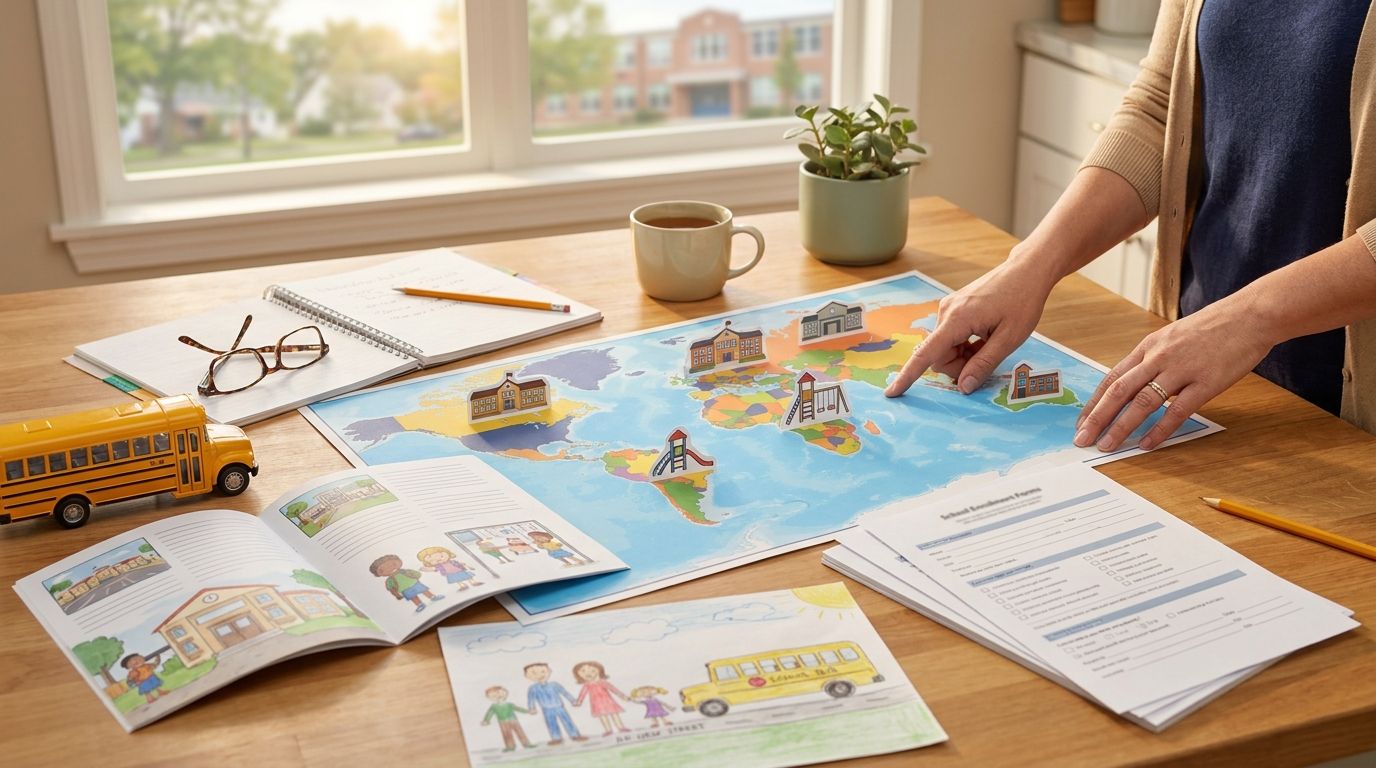
At 7:12 on a rainy Tuesday, Maya Camp stood in her kitchen with one lunchbox open, one permission slip missing, and a school search spreadsheet glowing on her laptop. She wasn't trying to find the fanciest school abroad. She wanted to know whether her family could get through an ordinary Wednesday without everyone losing their minds.
When you're moving abroad with kids, compare the whole family routine, not just school tuition or test scores. Look at school language, childcare hours, transport, holidays, after-school care, healthcare access, and how much time your children will have to rest and play.

That question matters because a school can look excellent on paper and still make daily life hard. A long commute, a six-week summer break with no childcare, or a school year that clashes with your work schedule can turn a hopeful move into a daily scramble.
Start with the family day you want to live
Before comparing countries, write down a normal weekday in your current home. Not the ideal version. The real one, including the part where somebody can't find a shoe.
Record these details:
- What time each child wakes up and leaves home
- Who handles drop-off and pick-up
- How long each adult spends commuting
- When homework, dinner, exercise, and bedtime happen
- Which hours require paid childcare
- How often school closes for holidays or staff training
Then write the version you hope to have abroad. You might want a shorter commute, more outdoor time, a later school start, or a reliable after-school program. You might also want your children to learn the local language without giving up access to English instruction.
This isn't a small exercise. It gives you a way to judge countries based on your actual life rather than a glossy list of "family-friendly" places.
Ask yourself what your family cannot easily change. A child who needs regular therapy may need a city with accessible services. A parent who works US hours may need childcare that runs later. A teenager may need a school that accepts American credits and supports a future university application in the United States.
You're allowed to care about ordinary things. A safe walk home counts. A grocery store near the apartment counts. So does having enough energy left to read two pages at bedtime.
What makes a country a good fit for American families?
The best countries for American families are not identical. A good fit depends on your children's ages, budget, work schedule, language goals, school preferences, and visa status. A country with low public-school costs may not work if you need English instruction and paid childcare nearby.
Compare each place across five practical areas:
- School access and teaching language
- Childcare before and after school
- Housing near the school
- Transport and commute time
- Healthcare, activities, and family support
With SafeHavenGuide's country comparison tools, you can test these needs against household cost and visa fit instead of judging a country by reputation alone. The point is not to find a perfect destination. There probably isn't one, unless someone has invented a place where rent is low, paperwork is instant, and every child enjoys vegetables.
Compare schools beyond tuition
Tuition is easy to notice because schools publish it. The other costs often appear later.
For international schools abroad, ask for a full fee schedule. Include application fees, enrollment fees, deposits, uniforms, meals, transport, books, technology charges, field trips, sports, and exam fees. Some schools charge a one-time capital fee or require a debenture. That pleasant surprise usually arrives after you've already fallen in love with the campus.
Ask the admissions office these questions before you apply:
- Is the school accredited, and by whom?
- Which curriculum does it follow?
- Does it accept US report cards and transfer credits?
- What happens if my child is still learning the school's main language?
- How many students are in a typical class?
- Is learning support available inside the tuition fee?
- What happens when a student joins in the middle of the school year?
- Does the school provide transport, meals, and after-school supervision?
- How many weeks is the school closed each year?
Accreditation doesn't tell you everything, but it gives you a starting point. The Council of International Schools and regional bodies such as the New England Association of Schools and Colleges publish accreditation information. Check the school itself rather than relying on a listing site.
The OECD's Programme for International Student Assessment, known as PISA, compares 15-year-old students across education systems. Its 2022 results can help you understand broad patterns in reading, mathematics, and science. They cannot tell you whether a particular school supports dyslexia, whether your child will make friends, or whether the bus ride takes 70 minutes each way.
Public schools deserve a careful look too. In many countries, public education is low-cost or free for residents, but eligibility can depend on your residence permit, address, child's age, and local enrollment rules. Instruction may be in the local language. That may be a genuine opportunity for a younger child, but it can be a steep transition for a teenager preparing for US college applications.
A useful school comparison sheet includes:
- Annual school cost in your own currency and local currency
- Total travel time each day
- Teaching language and language support
- Curriculum and graduation credential
- Class size and learning support
- Start dates, holiday dates, and closure periods
- Application deadline and required documents
Don't compare a school in a city center with one in a distant suburb as if they offer the same day. Housing near an affordable school may cost more. A cheaper home farther away may create a commute that eats the savings.
Treat childcare as part of the school budget
Childcare does not stop when school begins. This is where many family budgets become unrealistic.
A school may end at 3:00 p.m. while your workday ends at 5:30. School holidays may add 12 or more weeks to the year, depending on the country and school. Younger children may need full-day care before they are old enough for primary school. Older children may need supervision, transport, or activities rather than traditional daycare.
Build a childcare map for the whole year. Mark:
- Regular school hours
- Before-school care
- After-school care
- School holidays
- Public holidays
- Teacher training days
- Summer and winter breaks
- Backup care for illness
Then ask how much each item costs and whether you can legally use it under your visa. Some countries regulate home-based care, nannies, and au pairs. Your residence status may affect your right to hire someone, and local employment rules may require a contract, taxes, or insurance.
The OECD tracks early childhood education and care across member countries. Its data shows that access, public support, and family costs vary widely. A country can have low preschool fees but limited places. Another may offer broad access while private care stays expensive in the specific city where you plan to live.
This is why "free school" does not always mean a low-cost family move. You may still pay for:
- Preschool before formal school begins
- A nanny or babysitter during work hours
- Summer camps and holiday programs
- School meals and transport
- Therapy or learning support
- Occasional care when a child is sick
Ask local parent groups about availability, not just price. A program that costs less is not helpful if it has a nine-month waiting list.
And leave room for the unplanned week. Somebody will get sick. Somebody will have a school play at 10:00 a.m. Somebody will forget that the school closes next Friday. Your budget needs a little slack, because family life has never respected a spreadsheet.
Compare routines, language, and belonging
School is where your child learns. It's also where they build a social life, hear the local language, and decide whether the new place feels safe enough to call home.
Ask how the school handles new students. Is there a welcome program? Does a teacher check in during the first month? Are parents included in communication, or do notices arrive only in the local language? Can your child join clubs without already speaking fluently?
Language support deserves specific questions. "English friendly" can mean that staff speak English at the front desk. It does not always mean your child receives lessons in English or gets help with academic vocabulary.
Find out:
- What language teachers use in class
- Whether language lessons are built into the school day
- How long support usually lasts
- Whether parents receive translated notices
- How students are assessed while learning the language
- Whether a child can continue their home language
You don't have to choose between local connection and familiar language. Some families use a bilingual school, a local school with support, or an international school while building community through sports and neighborhood activities.
Age changes the calculation. A four-year-old may absorb a new language through play. A 14-year-old may worry about exams, friendships, and losing progress toward a US diploma. Ask your children what they fear, but don't make them carry the final decision. You're the adult with the visa forms and the budget calculator. They're allowed to have feelings about the move without becoming the project manager.
Also compare the calendar. School terms, lunch schedules, homework expectations, and vacation timing can differ sharply. In some places, children return home for lunch. In others, they stay at school all day. Some schools assign little homework in the primary years, while others expect regular evening work. (We met one family in Lisbon who didn't realize their kids would come home for a two-hour lunch break. Their whole work schedule had to shift.)
The best routine is the one your family can repeat. A school that leaves everyone calm at 4:00 p.m. may serve you better than one with a famous name and a punishing commute.
Build a country comparison you can trust
Once you have school and childcare information, put each country or city into the same comparison table. Don't let one destination win because it gave you better weather during a two-week visit.
Score each option from one to five on:
- Total education and childcare cost
- Availability of suitable schools
- Language fit
- Commute and transport
- Holiday coverage
- Healthcare and therapy access
- Housing near school
- Visa and residence requirements
- Support network and community
Write a short note beside every score. "Four for school cost" is less useful than "public school is affordable, but our child may need one year of language support." Notes protect you from wishful thinking later.
Separate facts from assumptions. A school website can confirm tuition and term dates. A parent group may explain how long enrollment takes. A visa office can confirm residence rules. A map can estimate distance, but you should test the route at school-run hours before treating it as real.
Use at least three sources for decisions that affect your move:
- The school's official admissions and fee information
- Government education, residency, or childcare pages
- Current local parent reports and neighborhood information
Look at the full household budget, not only school costs. Add rent near the school, transport, food, healthcare, insurance, activities, and occasional trips back to the United States. A country can have affordable education but expensive housing in the areas where suitable schools are located.
You can start with the free six-question SafeHavenGuide quiz at /preview. It returns three country matches and a cost figure without requiring a signup. Use that result as a starting point, then test each match against your school and childcare notes. The full ranked shortlist compares all 66 countries against budget, family needs, safety, and visa fit.
The practical next step is simple: choose two countries and one city in each. Contact three schools per city. Ask the same questions. Price the same childcare hours. Map the same weekday. You will learn more from that small, fair comparison than from another evening spent scrolling through "best countries for American families" articles.
Moving abroad with kids asks a lot of you. You're weighing opportunity against disruption, and hope against the very ordinary need to get everyone fed before bedtime. If the comparison feels emotional, that doesn't mean you're doing it badly. It means you understand that a family move is not a vacation decision.
Give yourself permission to reject a beautiful option that makes daily life impossible. Give yourself permission to choose a less obvious country because the school, childcare, budget, and rhythm fit better. Then take one concrete step this week: request fee schedules from three schools and place their answers in the same table.
FAQ
What should I compare first when moving abroad with kids?
Start with the daily routine: school hours, childcare coverage, commute, language, housing, and healthcare access. Tuition matters, but it cannot show whether your family can manage pickup, holidays, illness, and work hours.
Are international schools abroad worth the cost?
They can be worth it when your child needs English instruction, a familiar curriculum, or a smoother transfer between countries. Compare the full cost, including fees, transport, meals, activities, deposits, and learning support before deciding.
Can American children attend public schools overseas?
Often, but eligibility depends on the country, residence permit, address, age, and local enrollment rules. Instruction may be in the local language, so ask about language support and the documents required before you sign a lease.
How do I compare the best countries for American families?
Compare countries against your own family's budget, school needs, work schedule, language goals, healthcare needs, and visa route. A country that looks excellent in a general ranking may not fit your child's age or your weekday routine.
Join the conversation
Subscribe to comment
Join SafeHavenGuide's newsletter to leave a comment and get new posts in your inbox.