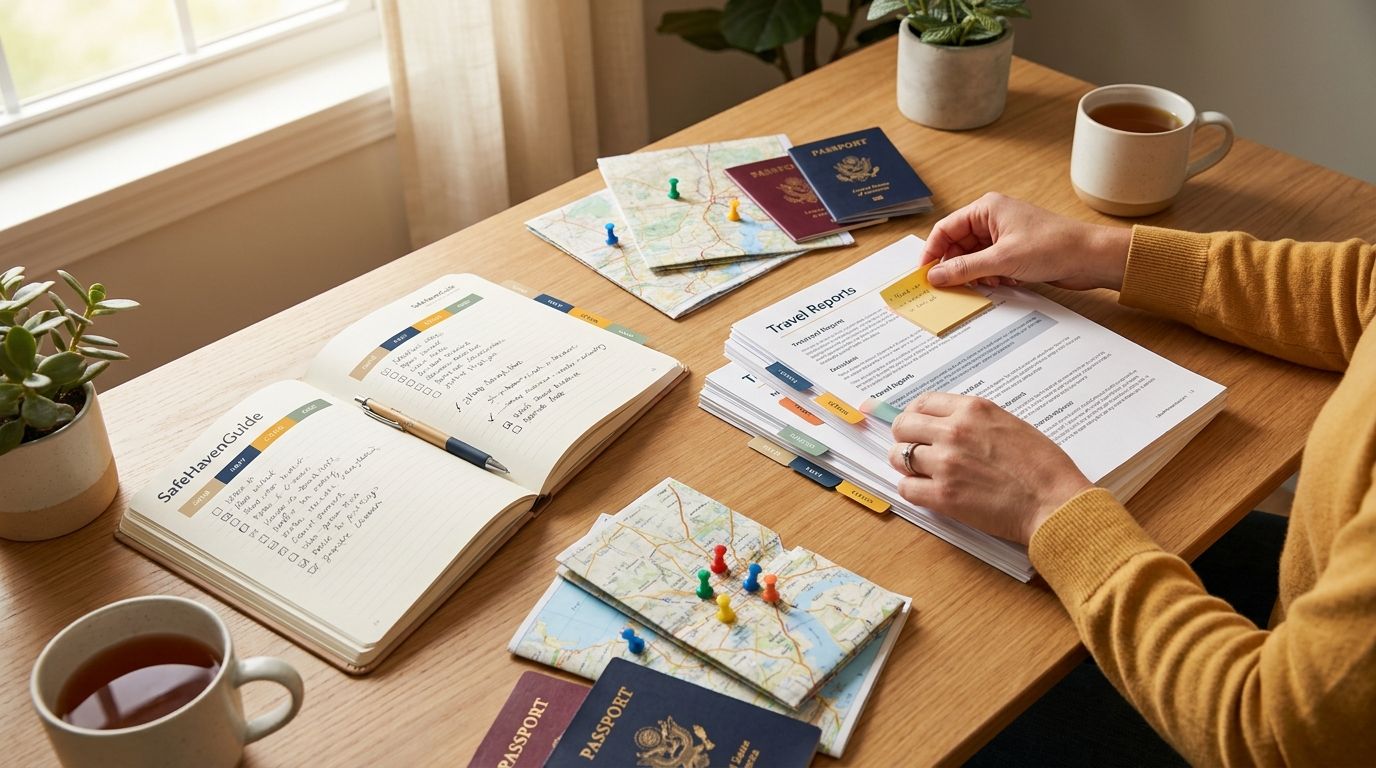
How to Evaluate Neighborhood Risk and City-Level Safety as an American
Crime stats are only half the story. Learn how to judge neighborhood risk, healthcare access, and emergency response before you sign a lease.

You're standing in the kitchen of a rental you like. The landlord is friendly, the light is great, and then your brain asks the question nobody answers on a tour: "If something goes wrong here, what happens next?" This guide gives you a practical way to evaluate neighborhood risk and city-level safety as an American by looking at crime patterns, healthcare access, and emergency response.
You will not be able to predict every bad outcome. But you can reduce surprises. And you can do it with a repeatable checklist that works whether the city is in Europe, Latin America, or Asia.
Start with your own "risk map," not the neighborhood brochure
Before you open a single crime website, write down what "safe" means for your household. Safety is personal. A quiet street can still be a bad fit if your child needs urgent care within 20 minutes and the nearest clinic is an hour away by bus.
So you start with three things you can actually measure:
- Your likely scenarios: theft, harassment, domestic incidents, car break-ins, workplace risk, medical emergencies.
- Your mobility reality: how you'll get around most days (car, rideshare, public transit, walking).
- Your tolerance for response time: what delay would be unacceptable for your family.
Then you build a simple risk map on paper or in a notes app. Mark:
- The exact places you'll rely on: grocery store, school, pharmacy, clinic, your commute route.
- The "worst-case" path: how you would get from home to care or to a hospital if you have to move fast.
- The emergency access points: where an ambulance or emergency vehicle would enter the area.
A quick example from a real kind of decision: you're considering an apartment near a tram line in Lisbon. The building looks fine, but the clinic you like is across a river, and buses run every 20 to 30 minutes. If your plan is to rely on transit during a weekend emergency, you've already made a choice about response time, whether you meant to or not.
Another example: you're touring a neighborhood in Montreal and the host says, "It's safe here." But your commute crosses an area with frequent night incidents reported by residents, and you'd walk the last block after a late work shift. Your risk map should include that last block, not just the apartment.
But what about "average" neighborhoods? A city can have pockets of safety and pockets of strain. Your risk map forces you to look at the exact routes and services that matter to you.
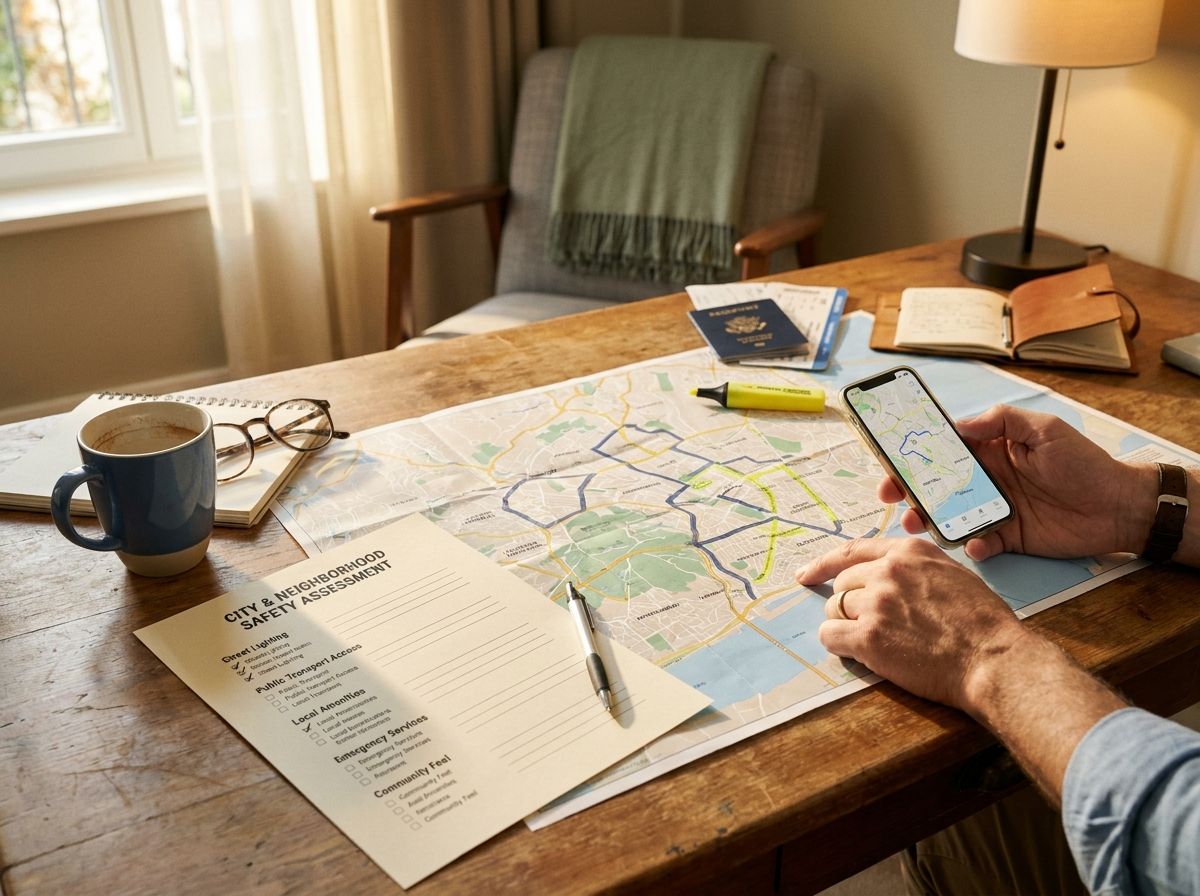
Evaluate crime risk the way a planner does: patterns, not headlines
Crime headlines are loud. Your job is to read them like data. You want to know what is common, what is rare, and what is changing.
A good starting point is public data where it exists, and local reporting where it doesn't. Many countries publish crime dashboards by district, and many police departments release annual reports. In the US, you can often find city-level data through open data portals. In other countries, you may rely more on local government crime summaries and reputable news investigations.
Here is the method that keeps you from getting fooled:
1) Compare the same crime type across nearby districts
Look at robbery, burglary, and violent incidents separately. A neighborhood can have low violent crime but higher theft from vehicles or apartment entrances.
2) Look for "time of day" and "location" patterns
The question is not only "how much crime." It is "when and where." Theft around transit stations at night behaves differently than street assaults near nightlife clusters.
3) Check for trend direction
If a district's reported theft drops for three years but violent incidents rise, you adjust your safety habits. If both drop, you feel better. If both rise, you ask deeper questions.
4) Treat "reported crime" as imperfect, not useless
Reporting rates vary by language access, trust in police, and whether people think reporting will lead to action. If you're moving as an American, you may be less likely to report what you witness. That changes what the data captures.
A concrete scenario: you're choosing between two areas in Barcelona. Area A has more visible nightlife, but Area B has more reports of break-ins in residential buildings. If your household parks on the street and stores bikes in a hallway, Area B may matter more for your day-to-day security. You can be "safe" from street violence and still spend every Sunday morning checking your car window.
Another scenario: in Chicago, a friend's apartment is in a "safe" part of the city until a nearby construction project increases foot traffic and distractions. The crime pattern shifts with the environment. That's why you should ask residents what changed recently, not just what was true last year.
A third scenario: in Mexico City, you might see inconsistent reporting across neighborhoods. You can still evaluate risk by looking at specific incident types that match your routine: taxi rides late at night, phone snatching near busy intersections, theft from parked cars.
Criminology has long shown that situational factors like lighting, access control, and routine movement affect where crime concentrates. You can see that in almost every city once you map your routes.
Test healthcare access with a "time-to-care" audit
Crime is one risk. Healthcare access is another, and it's often the one people ignore until a medical scare forces the issue.
You want to know three things:
- How quickly you can reach appropriate care for your likely emergencies.
- How easy it is to get from your home to that care when you are stressed.
- How language and paperwork affect the first 30 minutes.
Start with the practical audit. For each neighborhood you're considering, calculate time-to-care using the most realistic transport mode. Do not use "best case" routes.
Try this:
- Pick two facilities: one hospital and one urgent care or clinic.
- Use public transit or walking times at the times you'd actually travel (weekday evening, weekend afternoon, late night if that's your routine).
- Add time for finding the entrance, parking, or waiting for triage.
Then ask about the healthcare system's structure. In many countries, emergency care is centralized and non-emergency care is handled through clinics or referral systems. That affects what you do when you need help fast.
The World Health Organization has repeatedly highlighted that timely access to emergency and essential services saves lives, and that transport barriers are a major factor in outcomes. Distance and delays matter. Full stop.
A scenario that hits home: you're moving to Amsterdam and considering a neighborhood that is pretty, quiet, and expensive. The hospital is close, but the nearest urgent clinic has limited hours and long waits. If your family needs same-day care for kids, you might feel safe but still be stuck at 7 pm on a Tuesday.
Another scenario: you're in Portugal and planning to rely on public transport. Your preferred clinic is near your workplace, not your home. If you get sick at home in the evening, you'll go to the clinic, not the hospital, because it's easier to reach. That changes your risk calculation entirely.
So you check:
- Are there walk-in services near home?
- Are there after-hours clinics?
- Is ambulance response supported by a reliable emergency number?
- Can you get prescriptions quickly if you need them?
Also check the boring details. Can you access care without complicated paperwork during an emergency? In many places, emergencies are handled first and billing comes later, but not everywhere. If you need medication for a chronic condition, you want a continuity plan before you sign a lease.
With SafeHavenGuide's adaptive learning system, you can turn this audit into a side-by-side neighborhood comparison so you don't rely on memory or gut feeling.
Emergency response: what happens between "help" and "help arrives"
When people say a city is safe, they often mean "crime is lower." But your real question is: "How fast and how effectively does the system respond to emergencies in my area?"
Start with the emergency number. Many countries use a single number like 112 (common across much of Europe) or 911 in the US and some other places. But the key detail is not only the number. It is how services coordinate across police, ambulance, and fire.
Then you check response capacity in the places you'd actually call from. Response time is affected by:
- Distance to the nearest emergency unit
- Traffic patterns and road design
- Weather and seasonal effects
- Construction and detours
- Whether your street has easy vehicle access
A practical test beats theory. Do this on your phone with a map:
- Look at your street and the nearest main road. If your block is narrow or has frequent parking congestion, emergency vehicles might slow down.
- Check whether your building has a clear entry point. A gate that needs a code can turn a fast response into a delay.
- Identify the nearest public landmark. Dispatchers often use landmarks when addresses are unclear.
A real scenario: you're considering a home in a neighborhood with cobblestone streets. It looks charming. It might also slow ambulance access. If the city has limited ambulance routes or if emergency vehicles avoid certain narrow streets, the "distance" you see on a map is not the whole story.
Another scenario: you're moving to a city where heavy rain floods certain underpasses. You can find this out by reading local transit disruption pages or neighborhood forums. Flood risk is not "crime," but it can slow emergency response just as surely.
The US National Fire Protection Association and other emergency-services groups have consistently emphasized that access and fire code compliance affect response outcomes. For medical emergencies, the same principle applies. Physical access is part of safety.
So ask these questions during tours:
- "If someone needs an ambulance tonight, how do emergency vehicles reach this building?"
- "Is there a doorman or a way for responders to enter quickly?"
- "Do you know if the street gets blocked by events or construction?"
If you can, talk to residents. Ask what they do when they need urgent help. People remember the last time they called, and their answer will tell you more than any listing description.
Build your neighborhood safety plan like you're already there
Once you evaluate crime data, healthcare access, and emergency response, you still need a plan. Safety is not only where you live. It is what you do.
Create a "day-to-day safety routine" that matches your risks. Start with property theft and personal security habits. Then add medical preparedness. Then add communication and documentation.
Here's a short checklist you can actually use:
- Lock strategy: confirm door hardware, elevator access, and whether packages are left in a safe location.
- Lighting: notice dark entrances, stairwells, and pathways from transit stops.
- Phone and wallet habits: decide where you store them when you commute.
- Medical essentials: keep a small go-bag with key info and medications.
- Emergency info: write down emergency numbers, your address in local format, and nearby hospital names.
Now add the "American-specific" reality that trips people up. You might be unfamiliar with local healthcare pathways and local police procedures. You might also face language barriers. Your plan should include a simple way to communicate your needs under pressure.
Practical tools that help:
- Save emergency contacts and local emergency numbers in the language you'll use.
- Carry a card with your medical conditions, allergies, and prescribed medications.
- Keep proof of address and your insurance or coverage details accessible.
A scenario: you're in Tokyo and you're used to calling a doctor through your US provider network. You learn quickly that the local system works differently. Your safety plan now includes knowing which clinic handles non-emergency issues and which hospital handles emergencies. Two different places, two different processes.
Another scenario: you're in the UK and you have a chronic condition. In an emergency, you don't want to spend time explaining your history. You want the information ready.
This is where SafeHavenGuide's adaptive learning system is useful. It helps you capture your household's risk profile and turn it into a checklist you can reuse for each move.
Put it all together: a scoring worksheet that keeps you honest
You can compare neighborhoods without pretending your spreadsheet is fate. The goal is to make tradeoffs visible.
Use a simple scoring worksheet. Give each category a score from 1 to 5 based on your audit:
- Crime risk: pattern and trend, plus how it matches your routine
- Healthcare access: time-to-care in realistic transport modes
- Emergency response: access to responders and likely delay factors
- Practical usability: language access, hours, and how easy it is to find care
Then add a "fit note." That is the one sentence that prevents you from choosing a place that looks safe on paper but isn't for your household.
Example fit notes:
- "Low violence, but high break-ins and street parking makes our routine risky."
- "Healthcare is close, but after-hours urgent care is unreliable for kids."
- "Emergency access is good, but our building entrance can delay responders."
Now run a final stress test. Imagine you are handling a real moment:
- It is 9 pm on a weekday. A family member has asthma symptoms.
- It is Saturday night. You return from dinner and your car is on the street.
- It is raining hard and you can't rely on walking.
Where would you go? How fast? How easy is it to explain what you need? If the answer is unclear, treat that as a real safety gap, not a minor detail.
Also remember what changes. A neighborhood can look better after a new clinic opens or after a bus line improves. It can look worse after construction or a shift in nightlife patterns. That's why you verify current access during your search, not from reviews that are two years old.
If you do this work before you sign, you get something valuable: confidence. Not blind confidence. The kind that comes from knowing exactly what you checked.
FAQ
How can I evaluate neighborhood crime risk if local crime data is hard to find?
Start with incident types that match your routine, then triangulate using multiple sources like open data portals (where available), local government reports, and reputable local journalism. If data is missing, you can still evaluate risk by mapping where incidents concentrate and asking residents about recent changes.
What should I check for healthcare access beyond "there is a hospital nearby"?
You should check time-to-care using your realistic transport mode at the times you would travel. Also verify urgent care or clinic hours, how referrals work, and whether you can communicate your needs during the first minutes.
How do I estimate emergency response time in a new city?
You can't get perfect numbers without local data, but you can reduce uncertainty by checking distance to emergency units, street access for vehicles, and building entry logistics. Do a practical route check from your home to the nearest main road and identify any delays like gated entrances or narrow streets.
Is lower crime always better for families moving abroad?
Not always. A neighborhood can have low violent crime but still create stress if healthcare access is limited, urgent care hours are short, or property theft is common. Safety is the combination of crime risk, medical access, and response practicality.
What is a realistic safety plan for day-to-day life in a new neighborhood?
Create a routine that matches your risks: lock strategy and lighting checks for property theft, a go-bag and medical info card for health issues, and saved emergency numbers with your address in the local format. Then practice what you would do in a real moment so it is not the first time you think about it.
Your next step: do the audit before you fall in love with the apartment
Pick the top two neighborhoods you like. For each one, write down time-to-care from home to a hospital and an urgent clinic at realistic times, then map your emergency access path. Next, compare crime patterns by incident type that matches your routine, and add one fit note that explains your tradeoff.
When you have that in writing, you can decide with fewer surprises. And you can move with your eyes open.
Join the conversation
Subscribe to comment
Join SafeHavenGuide's newsletter to leave a comment and get new posts in your inbox.