
How to Choose the Right Visa Path as an American: A Decision Framework
Work, family, study, or retirement? Use a simple framework to match your situation to the right visa path and next steps.

You are standing at the kitchen counter in Austin, staring at a spreadsheet titled "Plan B" because the first visa path you picked felt like guessing. The good news: you can stop guessing. This framework helps you choose the right visa path as an American by sorting your situation into the visa categories that actually fit, then narrowing to the right option and the evidence behind it.
With SafeHavenGuide's adaptive learning system, you can turn your answers into a clear checklist of what to prepare for work, family, study, or retirement pathways, without pretending one form fits all.
Start with the one question that decides everything
Before you look up visa names, answer this: What is the real reason you want to live in that country?
That reason drives the visa category. Work visas exist because an employer needs you. Family visas exist because a qualifying relationship exists. Study visas exist because an institution accepts you. Retirement visas exist because you meet the financial and age requirements and the country accepts your situation.
If you force your story into the wrong category, you will feel it in two places: your document list will look strange, and your timeline will stretch. I once built a whole folder of "work" evidence when the real issue was family ties. The folder was beautifully organized and completely useless.
Use this quick filter. Pick the category that matches your current reality, not your hopes.
- Work: You have a job offer or a realistic path to one through a recognized work process.
- Family: You have a qualifying relative in the destination country or a pathway through marriage, partnership, or dependent status.
- Study: You have an admission offer or a credible enrollment plan at a recognized school.
- Retirement: You meet the age and financial conditions and the country's rules allow retirement-based residence.
If you feel stuck between two categories, that is a normal sign you need to clarify your main reason. Many Americans end up with mixed plans. A person might move initially for study and later switch to work, for instance. That is not a problem. It is a sequencing problem.
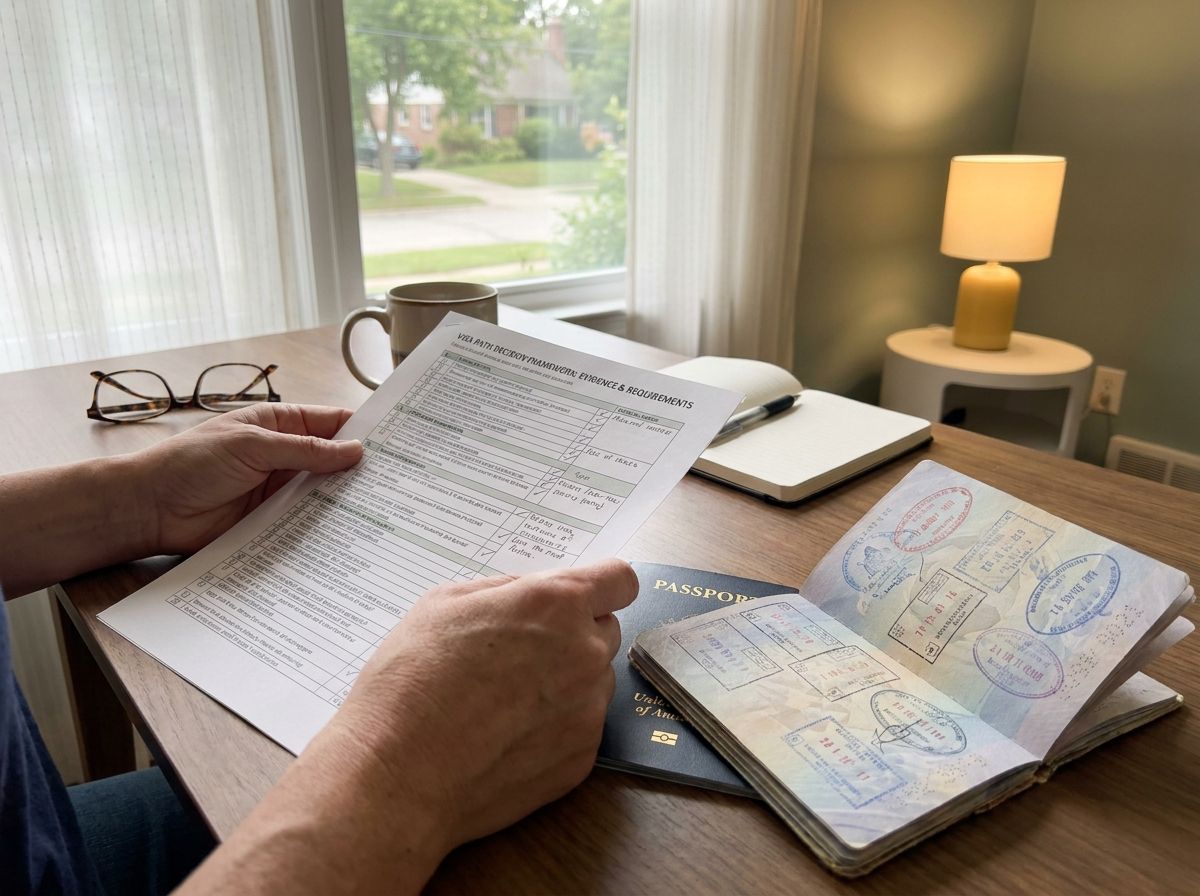
Build your "visa evidence map" (the documents that prove you)
Once you pick a category, you need evidence. Every visa path has a core set of proof, even when the details differ by country.
Think of your application like a story that must be supported with receipts. Immigration officers do not just want your intentions. They want your facts.
Here is the evidence map you should build for each category. You are not collecting everything at once. You are identifying what you will need so you can start the right tasks now.
Work evidence map
Work pathways typically require proof that you will work legally and that the employer process is legitimate. Common evidence includes:
- A job offer letter that matches the role and salary expectations
- Employer documents and registration, depending on the destination
- Proof of your qualifications (degrees, licenses, work history)
- Sometimes a labor market check or a work permit sponsorship step
In many countries, the work authorization process involves labor checks or employer sponsorship requirements. The exact name varies, but the idea is the same. If there is no employer sponsorship, your "work" story usually needs a different route, like a self-employment pathway, a specialized talent category, or a study-to-work plan.
Family evidence map
Family pathways usually require proof of the relationship and your eligibility as a dependent or partner.
- Marriage or partnership documents
- Birth certificates showing parent-child relationships
- Proof of the relative's status in the destination country
- Proof of ongoing relationship where required (for some partner cases)
Keep this in mind: the U.S. Department of State has long emphasized that civil documents must be complete and consistent. Many other governments run on the same principle. If your dates or names do not match across documents, your application can get stuck in "clarification mode."
Study evidence map
Study pathways often require proof of admission and your ability to fund and attend.
- Acceptance letter from a recognized institution
- Evidence of tuition payment or funding
- Proof of ties or intent to follow study requirements (varies by country)
- Academic records and sometimes language proof
Retirement evidence map
Retirement-based residence usually requires:
- Proof of age eligibility
- Proof of income, savings, or pension
- Proof that you can live without working (in places where retirement visas restrict work)
- Sometimes health insurance or medical clearance
When you build your evidence map, you stop feeling overwhelmed. You also stop wasting time on the wrong category.
Use a scoring worksheet to narrow your options
Now you have category candidates. Next step: narrow to the options that match your constraints.
You can do this with a simple scoring worksheet. Score each visa option you find, even the "maybe" ones, on five factors. Use a 0 to 2 scale:
- 0 = does not fit
- 1 = partially fits
- 2 = fits well
The five factors
1) Main purpose fit
Does the visa category match your real reason to move?
2) Evidence readiness
How much of the required evidence is already available? Be honest. "I think I can get it later" scores low.
3) Timing fit
How soon do you need a decision? Some pathways require long employer processes, while others depend on admissions cycles.
4) Work permission reality
If you need to work immediately, check whether the visa allows work and under what conditions. Many study visas restrict work or require separate permission.
5) Risk tolerance
Some pathways are more discretionary. If you dislike uncertainty, prioritize options with clearer eligibility rules.
Concrete scenario 1: the "job offer vs. job search" mismatch
In Chicago, Jordan has a degree in data analytics and wants to move to Ireland. Jordan keeps searching "work visa Ireland" and finds multiple options. The scoring worksheet makes the problem obvious.
- Main purpose fit: 2
- Evidence readiness: 0 (no offer yet)
- Timing fit: 1
- Work permission reality: 0 or 1 depending on route
- Risk tolerance: 1
Jordan chooses to pursue a plan tied to an actual employer step, not a vague "job search" approach. That decision saves months.
Concrete scenario 2: the family case that needs document cleanup
In Phoenix, Samira is moving to Germany to join her spouse. She has marriage documents, but her name spelling differs across her U.S. passport, marriage certificate, and a prior divorce decree. Her worksheet shows family purpose fit at 2, but evidence readiness at 0.
She spends four weeks aligning documents before submitting. Her application becomes boring. Boring is good.
Concrete scenario 3: the study plan that becomes a work plan
In Boston, Daniel gets accepted to a master's program in Canada. He wants to work afterward. His worksheet scores study at 2 for main purpose. It also scores timing at 2 because the admission letter is already in hand.
For work permission reality, Daniel scores low because he expects restrictions during study. That is fine. His plan is to apply for work authorization when eligible after arrival, following the specific rules for the study-to-work transition.
This worksheet does not pick the visa for you. It stops you from picking blindly.
Match your category to your life stage (and your constraints)
People pick visa paths by reading headlines. That is how you end up with the wrong paperwork.
Instead, match your category to your life stage and constraints. Ask yourself what you can change and what you cannot.
Work as a "move now" option
Work visas can be a move-now choice when you have a clear employer pathway. If you do not have an offer, you might still be able to move through work-adjacent routes like specialized programs, intracompany transfer (if eligible), or a study plan that leads to work.
But be careful with timelines. Employer sponsorship processes can take months. If you need a fast move because of a family situation, study or family pathways might be more predictable depending on your circumstances.
Family as a "relationship proof" option
Family visas are often the right choice when a qualifying relative has stable status in the destination country. The constraint is rarely "do I love them enough." The constraint is whether the relationship evidence meets the specific rules.
Some countries treat dependent eligibility differently for age thresholds, income requirements, or household conditions. If you are moving with parents, siblings, or adult children, check whether those relationships qualify under the destination's family categories.
Study as a "structure and permission" option
Study visas can be the most straightforward path when you want to move for a defined program. The constraint is that you must be accepted and able to fund tuition and living costs.
If you plan to work during study, check the rules early. Many places allow limited work but require registration or impose weekly-hour caps. You do not want to find that out after arrival.
Retirement as a "financial and age" option
Retirement visas are not just about having money. They are about meeting the destination's eligibility conditions and restrictions on work.
If you are 58 and thinking "close enough," do not assume. Age rules are exact. Financial requirements can be tied to specific income sources, bank statements, or insurance.
With retirement, you also want to think about healthcare continuity. Some countries require specific health insurance coverage for residence. If you are planning to rely on private insurance, start comparing policies early.
A small but useful habit: write a one-paragraph "life stage statement." Something like: "I am moving with a spouse, I need to work within 6 months, and I can relocate within 90 days." Then test each visa category against that statement.
Build a timeline that matches how governments actually move
Visa decisions follow government workflows. Work authorization has one rhythm. Family reunification can have another. Study admissions run on academic calendars. Retirement residence can depend on document verification and financial checks.
You do not need to memorize every step. You do need to build a timeline that matches your category.
Start with three dates
1) Your target departure date
2) The date you need to be in the country (work start, school start, family reunification)
3) The earliest date you can realistically submit a complete application
Then work backwards.
Add "document time," not "form time"
Most delays come from documents: apostilles, translations, medical checks, background checks, and getting employer or school paperwork to match the exact format required.
A practical rule: if a document takes more than two weeks to obtain, treat it as a project, not a task. Put it on your calendar now.
Use a "two track" plan
If you are unsure between two categories, run two tracks in parallel until you have clarity. Do not submit two applications unless you have a clear reason and understand the risks.
Instead, prepare evidence for both categories:
- Track A: documents you already have and will reuse
- Track B: documents that are category-specific
When one track becomes stronger, you stop the other.
Concrete scenario 4: the school start date trap
In Seattle, Maria plans to move to Spain for a master's program. She finds acceptance in May but wants to submit immediately. Her translation of documents takes longer because her local translator needs time to schedule notarization.
She shifts her plan: she submits the study visa application closer to the school's enrollment window, not her emotional deadline. Her application becomes complete and consistent.
That is the whole game. Complete and consistent beats fast and messy.

Avoid the common traps that make good candidates look risky
You can do everything "right" and still get delayed if your application looks incomplete or inconsistent.
These are the traps that show up again and again.
Trap 1: mixing categories in your story
If your form says "work" but your evidence map looks like "family," you create confusion. Immigration officers read your application as a whole.
Fix: write your story to match your chosen category. Then align every document to that story.
Trap 2: assuming translations and dates do not matter
They matter. Many countries require certified translations and exact name matching.
Fix: keep a single source of truth for your legal names and dates. Use your passport as a baseline unless the destination requires otherwise.
Trap 3: ignoring work permission constraints
If you plan to work and your visa does not allow it, you can end up stuck waiting for permission.
Fix: check work rights before you sign anything. If you need income immediately, prioritize visa paths that allow work or have a clear work authorization pathway.
Trap 4: picking a visa because it sounds similar
Some visa names sound close. The eligibility rules can be very different.
Fix: compare eligibility criteria line-by-line. If the destination has specific requirements for education, income, relationship duration, or age, do not hand-wave them.
Trap 5: forgetting healthcare and living cost realities
Even when a visa is approved, your move can fail if you cannot sustain yourself.
Fix: estimate your monthly costs and check whether the visa category restricts access to work. For many Americans, healthcare costs become the deciding factor for how quickly they need income.
Worth knowing: the U.S. Social Security Administration and many international benefits systems have different eligibility rules by age and status. That matters for retirement planning and for family dependency planning. When your income story is unclear, your "proof" story becomes unclear too.
With SafeHavenGuide's adaptive learning system, you can map these traps into a pre-submission checklist so you catch mismatches before you spend money on translations and notarizations.
Make your final choice with a pre-submit checklist
At this point, you should have:
- A category that matches your real reason
- A short list of visa options within that category
- A timeline that accounts for documents and approvals
- A scoring worksheet that shows why your choice fits
Now do a pre-submit check focused on what actually causes rejections and delays.
Pre-submit checklist
- Your story matches your category (work, family, study, or retirement)
- Your legal names and dates match across documents
- Your evidence map is complete for the category
- Your translations are certified and accurate
- Your funding or sponsorship story is credible and documented
- Your work permission plan matches your timeline
- Your application is consistent, not just "mostly done"
If anything fails, treat it as a fixable gap, not a sign you are doomed. Most issues are paperwork issues.
And yes, paperwork issues can still be annoying. But they are solvable.
Where you should get help
You do not need to hire someone for every case. But consider professional help when:
- You have complex family situations (previous marriages, complicated dependency)
- You need a specialized work category
- Your documents are inconsistent or incomplete
- Your timeline is tight and you cannot afford rework
If you do get help, bring your evidence map and scoring worksheet. It makes your questions sharper and helps you avoid paying for generic advice.
FAQ
Which visa path should I choose if I have both a job offer and a spouse abroad?
Choose the category that matches your primary reason to live there. If the job offer is the main driver and you can document the employer sponsorship process, work may be the cleanest path. If the spouse relationship is the strongest and you qualify directly, family may be simpler. You can also run a two-track evidence plan until you see which option is more consistent.
Can I switch from a study visa to a work visa after I arrive?
Often, yes, but the rules depend on the destination. Many places allow a transition after meeting specific conditions such as program completion, job matching, or work authorization steps. Plan your evidence and timeline so you can apply when eligible, not when you feel ready.
What documents usually cause the most delays for Americans?
Translations, apostilles, name and date mismatches, and missing relationship or funding evidence are common delay sources. If you have a prior marriage, multiple name changes, or documents from different states, it is worth doing a consistency pass early. Treat document procurement as a project with deadlines.
Is a retirement visa worth it if I might want to work later?
It depends on the destination's work restrictions for retirement-based residence. Some retirement visas restrict work, which can make your plan harder if you need income or want a career change. If work is part of your future, consider whether a different category better matches your long-term plan.
How do I choose between two similar visa options in the same category?
Use a scoring worksheet tied to evidence readiness, timing, work permissions, and risk tolerance. Then compare eligibility criteria line-by-line, not by name similarity. If one option requires proof you already have and the other relies on documents you do not yet have, that difference usually matters.
Next step
Pick your real reason to move today, then write your one-paragraph life stage statement. Next, build your evidence map for that category and score your top visa options on the five factors. If you do that before you start filling forms, you will feel the difference immediately.
Join the conversation
Subscribe to comment
Join SafeHavenGuide's newsletter to leave a comment and get new posts in your inbox.