
Cost of Living Comparisons for Families: Portugal vs. Spain vs. Italy (Rent, Schools, Groceries)
Rent, schools, and groceries can swing your monthly budget more than you expect. Here’s how Portugal, Spain, and Italy compare for families.

On a Tuesday in Lisbon, you stand in a kitchen with a sticky note that says "groceries: 180 euros." Your partner checks the rent email again. Then your brain does that math loop: "Is this cheaper than Barcelona or Rome for a family of four?"
This guide gives you a practical comparison of Portugal vs. Spain vs. Italy for families, focusing on rent, schools, and groceries. You'll get realistic ranges, plus a few planning moves that cut the surprise factor when you move.
The thesis: housing drives the monthly gap, schools drive the stress, groceries decide the daily mood
If you only remember one thing, remember this: rent usually creates the biggest monthly difference between Portugal, Spain, and Italy. Groceries come next, because they hit your week-to-week spending, not just your lease. School costs and logistics can be less obvious until you try to enroll, choose between public and private, and sort out after-school care.
A family budget also shifts based on where exactly you land. A "Portugal" comparison that ignores the Lisbon vs. Porto split is like comparing "California" without mentioning Los Angeles. The same applies to Spain and Italy. Madrid and Barcelona can feel like different planets compared with smaller cities, and Rome vs. Milan is its own separate argument.
So this article compares three countries through a family lens. It uses common, public sources for broad cost levels, and it adds the kind of detail you only absorb when you're actually shopping for diapers and decoding school enrollment forms.
Because yes, those forms always show up at the worst possible time.
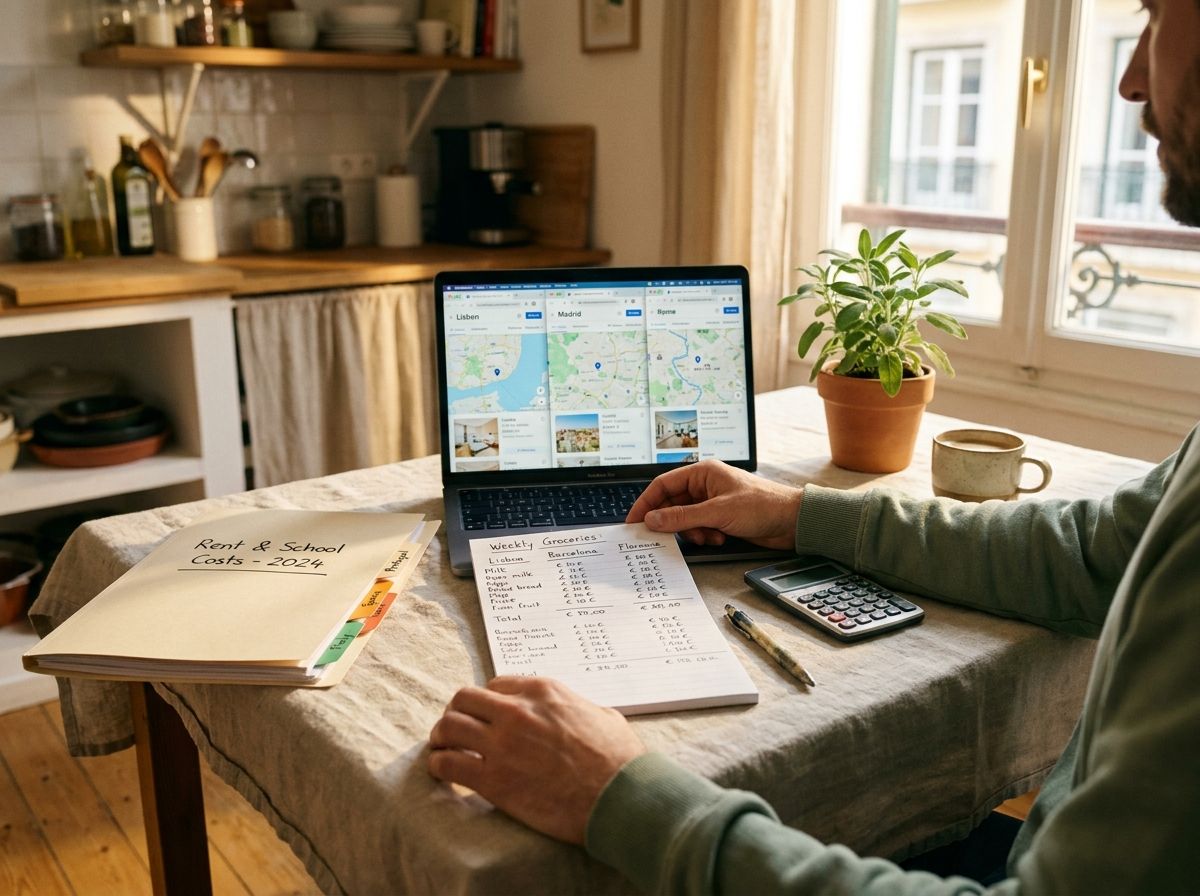
Quick baseline: what a typical family of four spends (and why the ranges overlap)
Let's set a baseline you can actually use. For a family of four, your biggest recurring categories are:
- Rent and utilities
- Groceries and household supplies
- School-related costs (tuition if private, transport, meals, after-school care)
- Childcare and activities (often the sneaky line item)
You'll see overlap in the totals because families make different tradeoffs. Pay more rent in a central neighborhood and spend less on commuting. Live farther out and pay more for transport and after-school care. The math shifts, but it doesn't disappear.
Here are reasonable planning ranges for a family of four, assuming you're not camped in the most expensive neighborhood in the biggest city. These are not quotes from a specific apartment listing. They are budget ranges meant for planning.
Rent: the usual order of magnitude
- Portugal (Lisbon area): often higher than Porto. Expect two- to three-bedroom rentals to be a major line item.
- Spain (Madrid/Barcelona): can be very expensive in prime areas, especially Barcelona. Smaller cities can soften the blow.
- Italy (Rome/Milan): Rome is often mid-to-high for rent; Milan can be more expensive.
In many expat budgeting conversations, people notice that Portugal can feel "cheaper than Spain and Italy" only if they avoid the most in-demand neighborhoods. Chase the same lifestyle footprint and the gap shrinks fast.
Groceries: price levels matter more than you think
Groceries in all three countries can feel similar if you buy the same types of food. But your basket changes your cost quickly. Buy more imported items and you'll feel it. Cook at home and you'll feel the benefit.
Schools: costs depend on your choices
Public schooling is generally the lower-cost path. Private or international schools can change the monthly picture fast. Also, the real "cost" of school is often time and logistics, not only tuition.
A 2023-2024 wave of price increases has made families pay closer attention to rent and food. The EU's inflation and food price volatility have been documented repeatedly by Eurostat and national statistics offices. The takeaway for you: plan for variability, not a single fixed number.
Rent for families: what changes between Portugal, Spain, and Italy (and how you can test it fast)
You want a rent comparison that holds up in real life. Here's a way to do that without pretending every apartment listing is the same.
Use a "family apartment" filter, not a "city average"
When you search, filter for a two- or three-bedroom apartment. Then compare it across neighborhoods that families actually use: near a metro line, near a school, or near a practical grocery store.
City-wide averages will make you overestimate your savings. Lisbon and Porto, Madrid and Valencia, Rome and Bologna are not interchangeable.
Example scenario 1: Lisbon vs. Porto for the Martins
The Martins are a family of four relocating from the US. They land in Portugal and decide to live near schools and parks. They compare Lisbon (two-bedroom with a small extra room for storage) and Porto (three-bedroom with a balcony).
What they notice in week one: Porto's rent is often lower, and they can find more space per euro. Lisbon can be workable, but the tradeoff is usually space and neighborhood choice. Their "family sanity" improves in Porto because the apartment feels less cramped, so they stop spending weekends rearranging furniture.
Example scenario 2: Barcelona vs. Madrid for the Nguyen family
The Nguyen family wants a large apartment and reliable transit. They compare Barcelona to Madrid with the same checklist: commute time to a school option, grocery access nearby, and whether they can find a three-bedroom without paying "luxury pricing."
Barcelona can cost more in rent, especially in areas that work well for families. Madrid can feel more flexible if you're willing to live slightly farther from the center. The Nguyen family ends up choosing Madrid because their after-school routine is simpler there. That matters more than any rent difference on paper.
Example scenario 3: Rome vs. Milan for the Rossi family
The Rossi family wants a stable housing market and strong school access. They compare Rome and Milan for a two- to three-bedroom.
Milan can be expensive, but it can also feel efficient. Rome offers more apartment variety, but some areas require more commuting. The Rossi family budgets for transport time because they know they'll pay for it either in rent or in daily logistics. One way or another, the city collects.
What to plan for in rent contracts
Before you sign anything, check whether utilities are included or billed separately, how heating works (some places have different heating setups that change monthly bills), and deposit rules and how quickly you can get the deposit back.
Build a "rent plus utilities" number for each city. That way you avoid the classic trap where rent looks affordable and the first utility bill makes you regret everything.
Schools for families: public vs. private, language reality, and what it costs you monthly
School is where families feel the difference between "cheap rent" and "cheap life." In practice, the cost of schooling is a mix of tuition, transport, meals, and your time.
Step 1: decide which school track fits your timeline
Most families end up choosing one of these paths:
- Public school (usually lowest direct cost)
- Private school (tuition varies widely)
- International school (often high tuition, but sometimes easier for language and curriculum continuity)
Language is the big divider. If you're moving with young kids, you'll often hear "they'll pick it up fast." That can be true, but you still need a plan for the first months. Kids absorb a new language quickly, adults still need forms, schedules, and parent communication to make sense on day one.
Portugal: enrollment and practical logistics
Public schooling in Portugal is often the lower-cost option, but your experience depends on your residency status and local enrollment rules. Families also need to understand how language support works for non-Portuguese speakers.
If you choose private, you'll see a tuition range that can vary by school and region. Your best move is to get the full list of fees, not just the tuition headline.
Spain: language support and the "paperwork tax"
Spain's public system is a common option, but families must handle enrollment steps that can feel bureaucratic. Move mid-year and the timing gets annoying. Move at the right time and it's often much smoother.
Private and international schools can reduce uncertainty, but they cost money and may require earlier planning.
Italy: public access and the local school culture
Italy's public schooling can be a lower-cost path, but schools vary in how they handle new students. Some areas are more welcoming and organized than others. Private schools exist across regions, and international schools are concentrated in specific cities.
What families actually pay besides tuition
Even if you choose public school, you can still spend money on school meals (if not included), transport passes or commuting costs, and after-school care or clubs.
If you choose private or international, tuition is only part of the picture. You'll also pay for uniforms, transport, meals, and sometimes registration fees.
With SafeHavenGuide's adaptive learning system, you can map school options to your move timeline and budget so you're not scrambling six weeks before the school year starts.
Groceries for families: how to compare baskets without getting tricked
Groceries are where families feel cost of living every single day. A "cheap country" can still get expensive if your grocery habits shift.
What changes your grocery bill fast
These factors move the needle:
- how much you buy prepared foods vs. cooking at home
- how often you buy imported products
- where you shop (supermarkets vs. local markets vs. convenience stores)
- whether you buy diapers, formula, and specialty items
Across Portugal, Spain, and Italy, you can keep your basket consistent by choosing the same categories: bread, eggs, chicken, vegetables, pasta, rice, dairy, fruit, and cleaning supplies.
Grocery math that works: build a "same basket" test
Pick a week and run a simple test. Create a basket with one protein (chicken or fish), one dairy set (milk or yogurt), one carb base (pasta or rice), 2-3 vegetables, fruit for snacks, and breakfast items you actually eat.
Then price it in each country at a major supermarket chain. Don't shop at the most expensive place because you're exhausted after a long day. That's how you accidentally compare convenience-store pricing to normal pricing.
Example scenario 4: the Alvarez family's "diaper shock"
The Alvarez family moves to Spain expecting groceries to be "not too different." The first week goes fine until diapers and wipes appear in the cart. Specialty baby items can cost more than standard groceries, especially if you're buying imported brands.
Their fix is practical: they switch to local equivalents for a month while they learn local brands. After that, they decide which imported items are worth the premium.
Example scenario 5: the De Luca family in Italy and the pasta trap
The De Luca family in Italy loves pasta. It feels like a win. Then they notice that "easy meals" get expensive when they buy pre-made sauces and packaged snacks for school lunches.
Their adjustment is boring but effective: they buy pasta and basic sauces in bulk, then cook a few lunch-friendly meals ahead of time. They still eat well, they just stop paying for convenience.
Groceries vs. eating out
Eating out varies by city and neighborhood. If you plan to eat at home most days, groceries stay manageable. Eat out often, and the country comparison becomes less about groceries and more about lifestyle.
Putting it together: rent + schools + groceries for three family moves
Now you need the "so what" version. Here are three planning templates you can copy.
Template A: "We want public school and cook at home"
This plan usually fits families who have at least one parent available for enrollment and school logistics, want to keep tuition low, and can commit to cooking and local shopping.
Budget logic:
- Rent is your biggest cost
- Groceries stay predictable if you avoid convenience purchases
- School costs are mostly transport and meals
Template B: "We want private school and faster language continuity"
This plan fits families who want smaller class sizes or structured language support, need a smoother transition, and can handle tuition.
Budget logic:
- Rent still drives the baseline
- Tuition adds a large fixed cost
- Groceries are easier because routines are stable
Template C: "We want international school and minimal disruption"
This plan fits families who move for a shorter contract period, prioritize curriculum continuity, and plan for higher monthly costs.
Budget logic:
- Tuition is the dominant school cost
- Rent can be higher because international-school families often cluster in certain neighborhoods
- Groceries may rise if imported items are part of the routine
A realistic note about timing
School starts at different times by region, and enrollment steps can be time-sensitive. Arrive mid-year and you might pay for temporary childcare or tutoring. That cost shows up in your budget even if tuition stays low.
So when you compare Portugal vs. Spain vs. Italy, compare your timeline too.
A practical decision framework you can use in one weekend
You don't need a perfect spreadsheet. You need a decision that survives real life.
Do this in two steps
1) Pick two target neighborhoods in each city
- One near transit
- One near a school option
2) Build three numbers for each location
- Rent for a family apartment
- A realistic groceries basket
- A school cost estimate (public or private)
If you do this, you'll see where the gap actually is.
A few rules that keep you from fooling yourself
- If you can't find a family apartment in your target area, don't assume it exists cheaper somewhere else. Families pay for time.
- If you plan to rely on prepared foods, your grocery comparison is meaningless.
- If you don't know the school track yet, don't pretend you know your monthly school budget.
Where SafeHavenGuide fits in your process
With SafeHavenGuide's adaptive learning system, you can organize your rent targets, school options, and grocery assumptions into a single plan. It's easier to adjust when new information comes in, like a neighborhood that's cheaper but adds 40 minutes to your commute.
That's the whole point. You're not trying to predict the future. You're trying to reduce the surprise.
FAQ
Which country is cheaper for families: Portugal, Spain, or Italy?
Portugal often feels cheaper when you compare rent and day-to-day costs, especially outside the most expensive neighborhoods. Spain and Italy can be similar depending on where you live and whether you choose public or private schooling. Your best comparison comes from pricing the same family apartment size and the same grocery basket in specific neighborhoods.
How much do private or international schools cost in these countries?
Private and international schools vary widely by city and school reputation. In many cases, international schools cost significantly more than private schools, and tuition is only part of the total. You should request a full fee list, including meals, transport, registration, and any required materials.
Are groceries really cheaper in Portugal than Spain and Italy?
Groceries can be cheaper in Portugal, but the difference depends on your shopping habits. If you buy more imported items or rely on prepared foods, the gap shrinks. If you cook at home and shop at mainstream supermarkets and local markets, the comparison becomes more stable.
What should families budget for besides rent and school tuition?
Most families forget transport, school meals, and after-school care. Those costs can turn a "low tuition" plan into a higher monthly total. Also include one-time move costs like deposits, setup purchases, and any temporary childcare.
How do I compare rent when listings vary so much?
Use consistent filters: two- or three-bedroom, near transit, and within a practical commute to school options. Then compare rent plus utilities, not rent alone. If utilities are unclear, add a conservative estimate so your monthly budget doesn't swing.
Join the conversation
Subscribe to comment
Join SafeHavenGuide's newsletter to leave a comment and get new posts in your inbox.