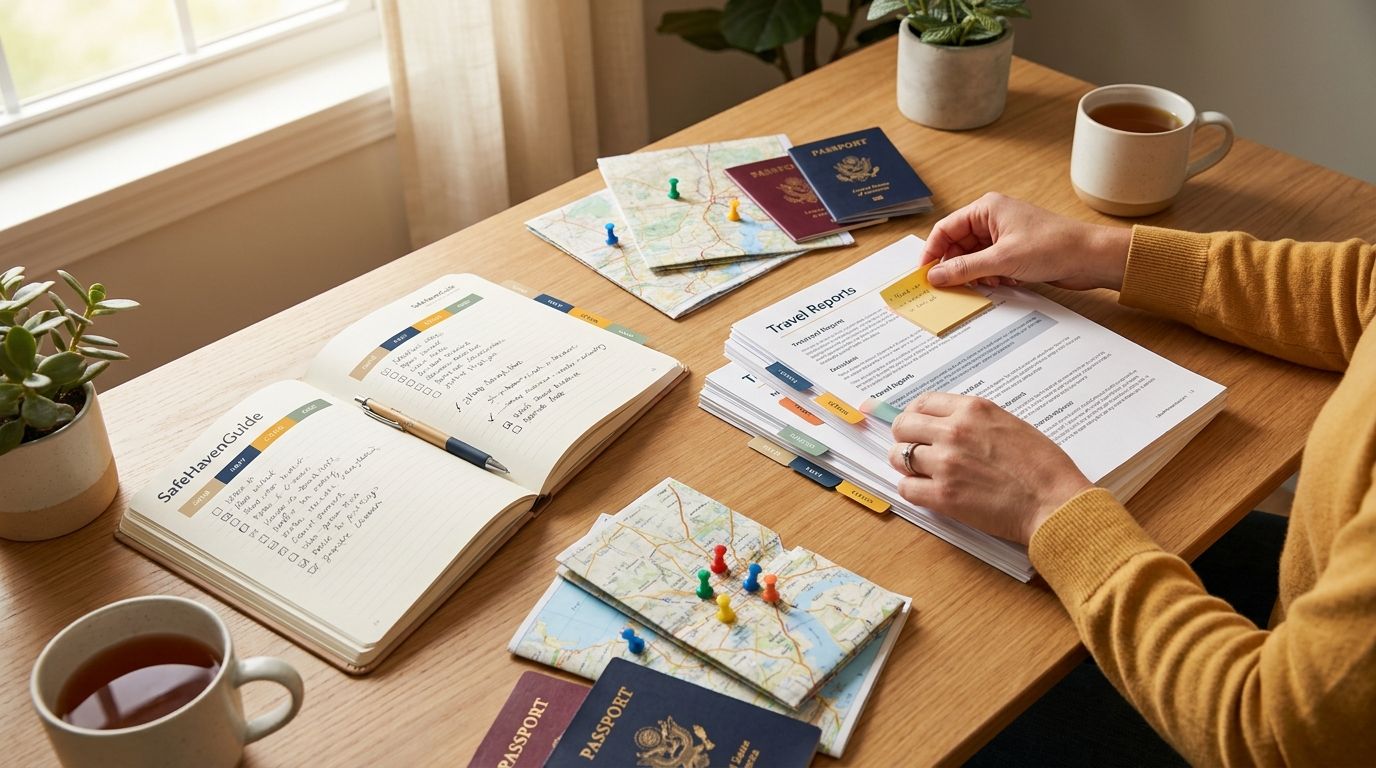
A 10-minute SafeHavenGuide walkthrough: from first idea to a researchable relocation plan
See how SafeHavenGuide turns a vague idea about moving abroad into a shortlist, budget, visa questions, and a practical research plan in 10 minutes.

At 9:42 on a Tuesday night, you're at the kitchen table with a cold cup of coffee, a half-finished spreadsheet, and twelve browser tabs open about moving to Portugal, Mexico, and Croatia. You are not ready to move tomorrow. You are ready to stop guessing.
This SafeHavenGuide walkthrough shows how a relocation planning app can turn that first rough idea into a researchable plan in about 10 minutes. You answer six questions, review three country matches with a cost figure, then decide what deserves deeper research before you spend weeks reading scattered advice online.

The goal is not to let an app make a life decision for you. The goal is to replace a foggy wish with a short list of countries, practical questions, and a sensible next move.
Minute 1: Name the move you are actually considering
Open the SafeHavenGuide preview at /preview when your idea is still rough. You do not need a finished budget, a chosen visa, or a five-year plan. You need a starting point.
The six-question quiz covers the parts of daily life that tend to shape a move far more than any vacation does. Your monthly spending range matters. So does your household size, preferred pace of life, safety needs, healthcare expectations, and visa situation.
Answer as the person you expect to be after the move, not as the person you are while browsing travel photos. A retired couple with $4,500 available each month should not answer like a single remote worker with flexible income, and a family with a school-age child should not treat housing as a simple rent comparison.
Try this example. You are Jordan, a 42-year-old software tester in Raleigh, North Carolina. You earn remotely, have a partner who may not work right away, and want a two-bedroom home near reliable healthcare. You can spend about $3,800 each month, but you need to keep an emergency reserve in the United States.
Jordan's answers create a more useful starting point than "Where is nice?" They describe a household, a budget, and a daily routine. That gives the moving abroad planning tool something real to compare.
Before you begin, write down these details:
- Your realistic monthly spending limit after taxes and debt payments
- The people, pets, or work obligations that would move with you
- The conditions you will not accept, such as unsafe streets or poor internet
- The visa questions you already know you need to answer
You can change an answer later. The point of this minute is to give the app a workable picture, not to defend a permanent decision.
Minutes 2 and 3: Read the three matches without falling in love with one
After the quiz, SafeHavenGuide returns three countries that fit your answers best, along with a cost figure. Treat the result as a research queue. It is not a promise that you will qualify for residency or enjoy every part of life there.
This distinction matters because a country can look affordable in a broad online comparison and still miss your specific needs. A low average rent does not help if you need a private school, regular specialist care, or a city with direct flights back to family. A popular visa route does not help if your income type fails the requirement.
Suppose Jordan sees Mexico, Portugal, and Croatia. That result does not mean Jordan should book a flight to the first country listed. It means those three countries deserve a closer look against the same household profile.
Use the three results to ask better questions:
- Which result has a monthly cost closest to my actual budget?
- Which visa route appears possible for my income and household?
- Which country has the daily routine I would still want in February?
- Which match depends on assumptions I have not verified?
Research from the Pew Research Center has found that Americans often describe financial security and family circumstances as major drivers of life decisions. A relocation decision works the same way. Your fit is not just a destination preference, it is the connection between money, obligations, health, work, and ordinary Tuesday life.
Take five minutes to write one reason each country might fit and one reason it might fail. This small act keeps the result useful. Otherwise, you may spend an hour staring at a score as if it were an oracle, which is a lot of responsibility to place on a colorful screen.
SafeHavenGuide's three matches give you a starting set. Your job is to test them.
Minute 4: Compare the cost figure with your own household budget
A country estimate becomes useful only when you hold it up against the life you actually intend to live. Open the cost comparison for each match and check how the monthly amount is divided. Housing, groceries, utilities, transportation, healthcare, and personal spending can pull in very different directions.
Do not copy the total into your budget and call the job finished. Replace broad assumptions with your own numbers. If you need a furnished apartment in a major city, use a city rent range rather than a national average. If you plan to own a car, include fuel, insurance, maintenance, and parking. If you take regular medication, find out what you will pay before and after local coverage kicks in.
Consider Priya and Daniel, a couple from Minneapolis. They have $5,200 per month after retirement income and expect to rent in Valencia, Spain. A general estimate may look comfortable. Their personal version shifts considerably when they add a larger apartment for visiting family, private dental care, two return flights to the United States, and a tax adviser during the first year. Real budgets always have a few of these invisible line items that only surface once you start filling in specifics.
Their first budget is not a prediction. It is a list of things to verify.
Use two columns:
- The app's estimated monthly cost
- Your adjusted monthly cost with your actual housing, transport, health, and travel needs
Then create a reserve line. Moving costs arrive before normal life begins. Deposits, temporary lodging, document fees, shipping, flights, and setup costs can all land in the same month. The U.S. Department of State advises Americans abroad to plan for local laws and financial conditions before departure, and that preparation includes more than the monthly rent.
A helpful rule is to run a lean version and a comfortable version. The lean version answers, "Could we manage?" The comfortable version answers, "Would we want to stay?" Both matter. A plan that works only when nothing goes wrong is not ready for a real move.
Minutes 5 and 6: Turn a country match into visa research
A match is not a visa decision. Open the country guidance and identify the residency routes that might fit your situation. Look for the income source, minimum funds, health insurance rules, document standards, application location, and renewal conditions.
The exact requirements belong to the relevant government or consulate. SafeHavenGuide can help you organize the questions, but official sources decide whether a route is open and whether your documents meet the standard.
For example, Marcus works for a U.S. company from Denver and is considering Spain. He sees a remote-work route and assumes the application will be straightforward because his salary clears the income threshold. Then he finds questions about employer permission, dependent coverage, insurance, criminal background documents, and how long his work arrangement must have existed. The route may still fit. It is no longer a vague internet idea.
Create a visa research sheet with these headings:
- Route name and who may apply
- Income or savings proof
- Health insurance standard
- Required U.S. records and their age limits
- Application location and estimated processing time
- Renewal, tax, and travel conditions
The FBI says its Identity History Summary is commonly used for personal review and certain international purposes, while foreign authorities may request specific formatting, authentication, or an apostille. That difference can affect your timeline. A document can be valid and still need another step before a consulate accepts it.
Mark every item as verified, needs confirmation, or not relevant. Do not treat an attractive visa page as evidence that you qualify. Treat it as a prompt to check the rule in the correct government source.
This is where how to research moving abroad becomes practical. You are no longer searching for "best countries for Americans." You are checking a specific route against your income, records, family, and intended arrival date.
Minutes 7 and 8: Build a country research brief
Pick one of the three matches for a closer look, but keep the other two visible. Then create a one-page brief that can guide your next week of research. A good brief makes unanswered questions obvious rather than burying them.
Use the SafeHavenGuide country report, cost comparison, housing guidance, and visa information as sections in that brief. If you save different household assumptions, you can compare a solo move with a partner move or a retirement scenario without relying on memory.
Your brief might contain:
- A target city and two backup cities
- A monthly budget range, not one perfect number
- Two possible visa routes
- A housing search plan and maximum rent
- Healthcare questions for your household
- A short list of documents to request from the United States
- A date for reviewing official sources again
Take Alicia, a 31-year-old nurse from Phoenix. She likes Lisbon, but housing prices and professional licensing make the decision less simple. Her brief sends her to compare smaller Portuguese cities, confirm whether her nursing credentials need formal recognition, and price a temporary rental before signing anything long term.
That is a useful result even if Portugal eventually leaves the shortlist. Research has eliminated a weak assumption and replaced it with a concrete question. Progress.
You can also use the free country pack at /free/{country} for a printable starting point. Download the pack for the country you are studying, then add your own notes. A paper copy can be handy when your tabs have multiplied beyond human supervision.
Keep the brief narrow. You are not writing a relocation encyclopedia. You are building a document that helps you decide what to verify next.
Minutes 9 and 10: Choose the next action, not the final country
The last two minutes should produce an action you can actually complete. "Research Portugal" is too broad. "Check the current income rule for Spain's remote-work route and save the government source" is clear enough to finish before the week is out.
Use the move plan checklist to turn your questions into deadlines. You can add document requests, housing research, insurance calls, school inquiries, pet requirements, and flight planning in the order that makes sense for your household.
A useful next-action list might look like this:
- Request a federal background check by Friday
- Compare two rental markets in the chosen city
- Call an insurer about visa-compliant coverage
- Check the consulate's document instructions
- Price a three-month temporary stay
- Ask an accountant about U.S. and local tax questions
The full SafeHavenGuide wizard ranks all 66 countries against your budget, family, safety, and visa fit. Use that wider ranking when the three initial matches raise a question like, "What am I missing?" A broader result can surface a country you never searched for because it was never part of your personal travel history.
You can also save scenarios. One version might use your current income. Another might assume a lower retirement income, a new school expense, or a move with a pet. Comparing those versions is more honest than pretending one budget will cover every possible future.
At the end of 10 minutes, you should have three things: a short list, a budget you can question, and one task with a due date. That is enough for today. A relocation plan grows through verified steps, not through one heroic night of browser tabs.
What to do after the walkthrough
Give yourself seven days to test the plan. Spend the first day checking visa information against official government sources. Use the next day to adjust housing numbers. Then contact a qualified tax or immigration professional if your situation includes complicated income, a business, dependents, or a professional license.
On day four, compare a second city in the same country. On day five, run your budget with a higher rent and an emergency medical expense. On day six, review the other two matches. On day seven, decide whether the country moves forward, needs more evidence, or leaves the list.
SafeHavenGuide is most useful when you treat it as a working file rather than a one-time quiz. Save the country reports, update the numbers, and record what you have verified. If your income, household, or timing changes, answer the quiz again.
Your next step is simple: open /preview, answer the six questions using your real household details, and save the three results. Then choose one country and write down the single visa or budget question you will verify before you do anything else.
FAQ
What does the SafeHavenGuide walkthrough do?
The walkthrough takes you from a broad idea about moving abroad to three country matches, a cost figure, and a short research plan. It helps you organize visa, housing, budget, and daily-life questions before you commit to a destination.
Is SafeHavenGuide a visa approval service?
No. SafeHavenGuide organizes visa routes and the questions you need to verify, but the relevant government or consulate decides whether you qualify. Check current rules with official sources before applying.
How accurate is the relocation cost estimate?
The estimate is a planning starting point based on your household profile and country information. Adjust it for your target city, housing type, healthcare needs, travel, taxes, pets, and other personal costs before making a decision.
Can I compare more than three countries?
Yes. The quiz returns three initial matches, while the full guided wizard ranks all 66 countries against your budget, family, safety, and visa fit. Saved scenarios let you compare different household assumptions.
What should I do after taking the quiz?
Choose one match and verify one specific question, such as the current income rule for a visa route or the rent range in a target city. Then record the source, adjust your budget, and add the next task to your move plan checklist.
Join the conversation
Subscribe to comment
Join SafeHavenGuide's newsletter to leave a comment and get new posts in your inbox.